
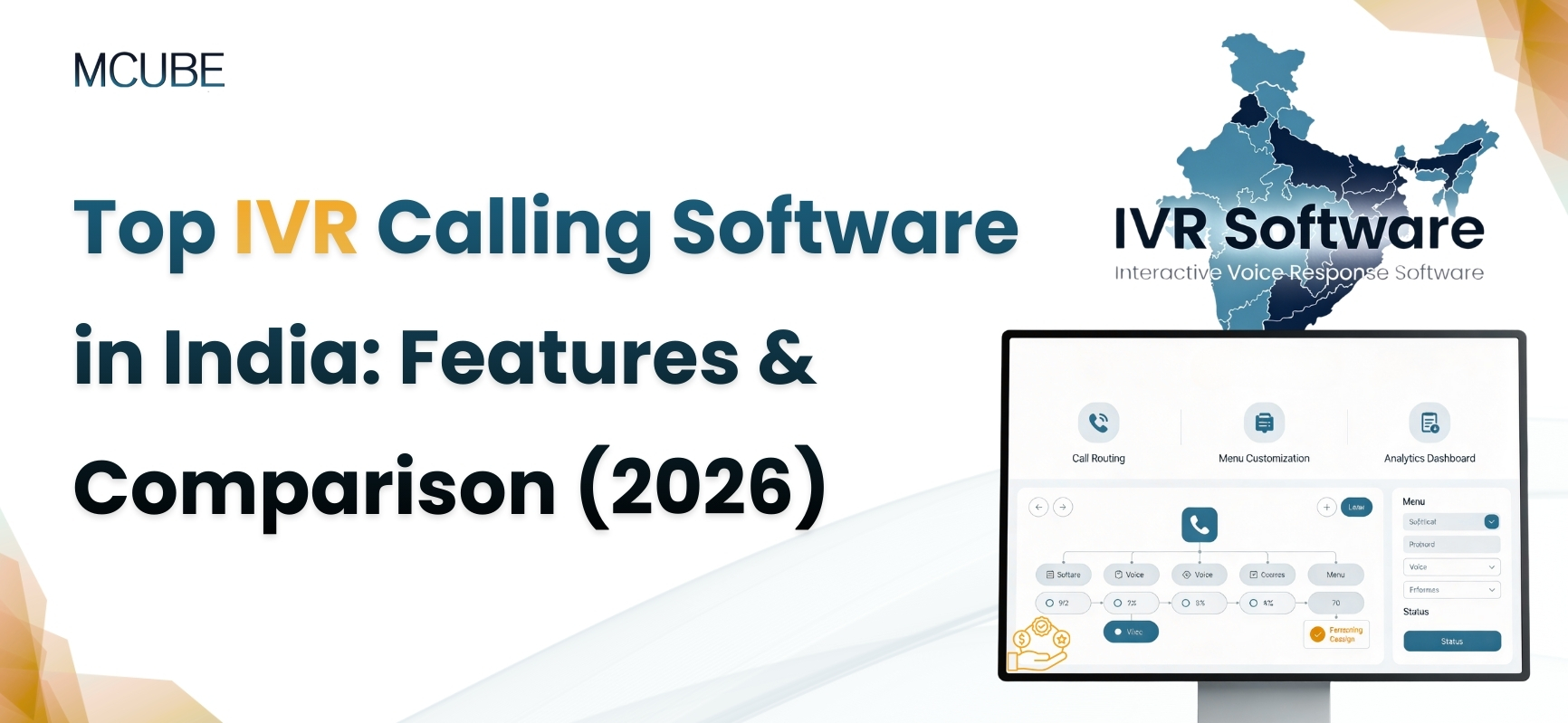
Indian businesses handle millions of customer calls every day. Some convert into revenue, some resolve issues, and some never even get answered. In a country where customers trust voice communication, it is crucial to manage all of them so that no customer calls are missed.
Industry estimates suggest that around 40% of the inbound business calls in India go unanswered or poorly routed, especially in peak hours. The unattended calls will directly result in lost leads, frustrated customers, a broken first brand impression, and a massive revenue leakage. Here, IVR can step in as the initial layer of your business intelligence.
What once sounded robotic and rigid can now act as your virtual receptionist, but how? The IVR calling software has evolved over time to understand the customer intent, routing calls packed with the context, enabling self-service, and collecting data from each interaction. So an interactive voice response system is not for answering calls but has the ability to decide who should answer the call, when, and why.
But do all IVR platforms deliver all of these? If not, which platforms in India are actually delivering the promise? Choosing an IVR platform is not based on features alone. It includes reliability, flexibility, data visibility, and long-term adaptability.
In this blog, let’s see a few top IVR calling software in India, comparing their strengths, assisting businesses to understand what truly separates a basic IVR setup from a future-ready calling system.
What Defines A Modern IVR Calling Software in 2026
An Interactive Voice Response (IVR) technology helps businesses to interact with callers through automated voice responses, and helps the callers navigate using menu options. But in 2026, this is an outdated definition.
A modern IVR calling system is a dynamic communication layer between customers and calling teams, and once a customer call enters the system, it greets, collects intent and context, and distributes the calls to the respective teams. Whether the caller has a sales enquiry, an existing customer seeking support, or is calling with an unresolved query from a previous interaction, modern IVR can adapt and route them efficiently.
Self-service and multi-level, well-structured menus have become a defining characteristic. For repeated and basic queries, the callers do not have to connect with agents, but can be resolved using the self-service menus available in the IVR. If the caller comes with an escalation or complex issue, the calls will be routed to the agent using various routing and distribution logics such as parallel, priority, weightage-based, or sequential.
Another shift is in data. Every interaction generates insights into call volumes, drop-off points, peak hours, frequently chosen options, and many more. This data will significantly help businesses to refine their workflows and take data-driven decisions to improve the CX.
This is precisely why not all IVR platforms are equal.
Key features to look for in IVR calling software in 2026
- Intelligent Call Routing and Easy Configuration
Calls should be intelligently routed by advanced IVR calling software according to caller intent, time of day, agent availability, or CRM information. In addition, the configuration needs to be straightforward so that teams can easily construct and alter IVR flows without technical support. This is a fundamental requirement for contemporary cloud calling services.
- Customizable IVR Menus and Self-Service Automation
Businesses may create multi-level menus and automate repetitive encounters with a scalable IVR system. Options for self-service shorten phone wait times and let users use IVR to answer frequently asked questions without interacting with an agent.
- CRM and Business Tool Integration
Context-driven IVR calls are guaranteed by integration with internal systems, ticketing tools, and CRM platforms. Caller history and purpose are sent to agents before to the start of a conversation when ivr calling software exchanges data with business tools.
- Multi-Language IVR Support
Multiple regional languages must be supported by IVR for Indian businesses. Multilingual IVR increases accessibility, fosters trust, and guarantees that cloud calling services provide consistent experiences for a range of clientele.
- Failover and Call Continuity
Automatic failover and call rerouting are features of dependable IVR calling software that provide a continuous connection. IVR calls must continue without affecting customers, even during outages or periods of high traffic.
- Call Tracking and Recording with Analytics
Modern ivr systems provide complete visibility into call journeys. Call tracking, recordings, and analytics reveal drop-off points, peak call hours, and performance metrics that help businesses optimize their cloud calling services over time.
5 Leading IVR Calling Software Used by Indian Businesses
Indian businesses rely on IVR to manage scale, reduce call overload, and ensure every customer interaction is routed with intent. The following IVR software providers in India are widely used across industries for their stability, cloud calling services, and ability to support modern IVR workflows.
| IVR Platform | Best Suited For | IVR Customization | Call Routing | Post-Call Automation |
|---|---|---|---|---|
| MCUBE | Mid-size to enterprise businesses | Multi-level, fully customizable IVR | Intent-based routing with 4 distribution logics | Automated call alerts, CRM updates, WhatsApp follow-ups |
| Exotel | Large enterprises | Configurable IVR flows | Rule-based routing | Automated callbacks, call logs, API-triggered actions |
| MyOperator | Small and mid-sized businesses | Basic multi-level IVR | Menu-based routing | Call notifications, lead updates, basic follow-ups |
| Knowlarity | High-volume operations | Multi-language IVR menus | Skill-based and rule-based routing | Automated call logging, CRM updates, task creation |
| Ozonetel | Contact centers and complex setups | Highly customizable IVR | Advanced routing logic | Post-call workflows, notifications, integrations |
Conclusion
IVR calling software is now an essential component of how Indian firms handle incoming contact at scale, as customer expectations about speed, accessibility, and consistency continue to rise. What started out as a simple call-handling tool has evolved into a strategic layer that affects revenue results, operational effectiveness, and customer experience.
Every call is answered, routed purposefully, and followed up on in a methodical manner when an IVR calling system is properly established. Modern ivr platforms enable businesses remain responsive even during peak volumes by enabling self-service and post-call automation, as well as by lowering missed calls and agent overload.
If your business is struggling with business calls, plan a well-orchestrated calling system with MCUBE to know more. Connect at 1800 419 2202.