
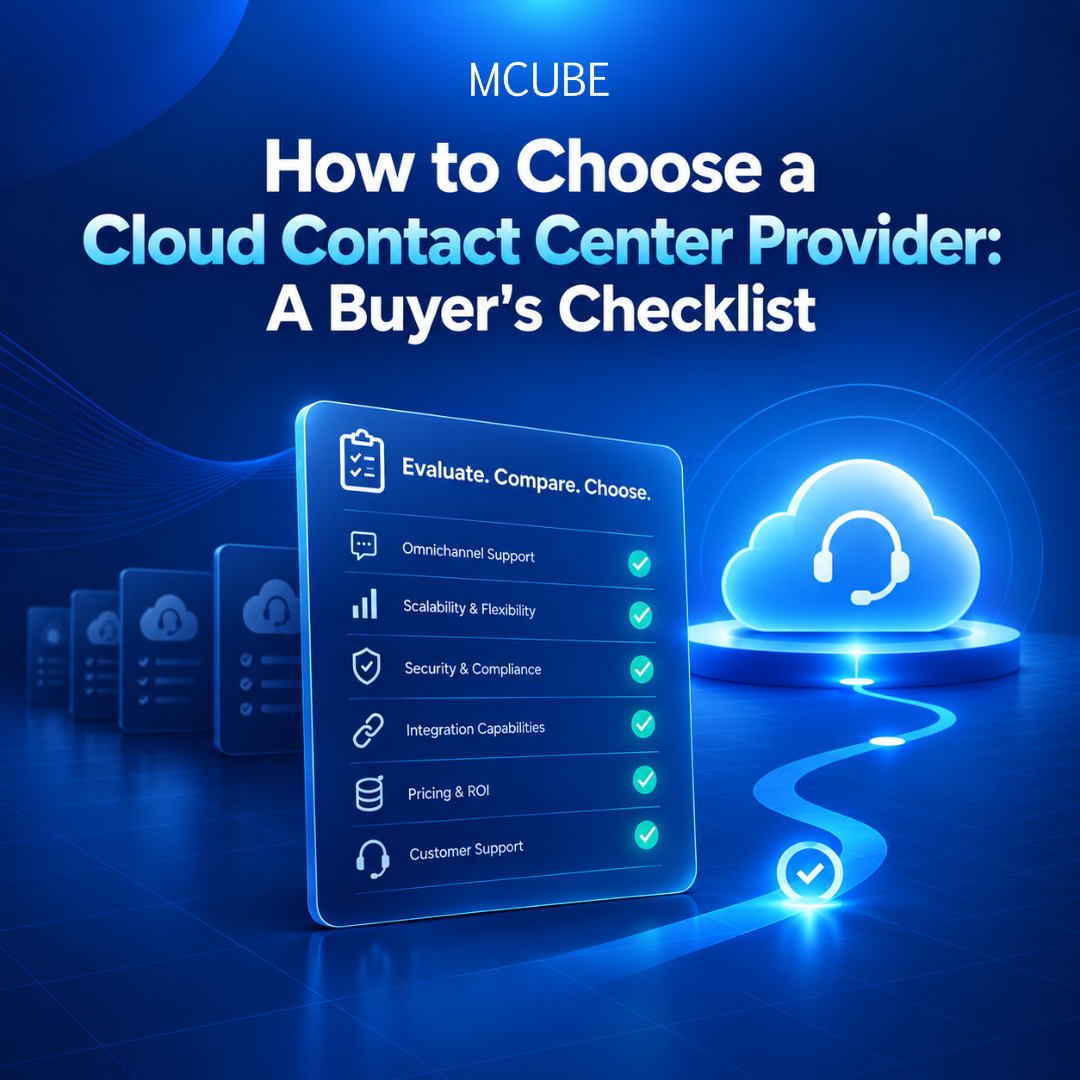
A few years ago, a mid-sized insurance company in Bangalore found itself losing customers over something almost embarrassing: missed calls. There were three tools agents were managing: one for calls, one for WhatsApp, and a follow-up spreadsheet. Repeat calls were made by the customers every time they were forwarded, and there was no record of the conversation history. By the time the problems were solved, the customers had already made up their minds to go to the competitors. There was no shortage of staff. The issue was with a system problem.
That’s the reason why selecting the right cloud contact center provider is important. The platform you choose determines your calls routing, the speed of agent response, ease of access to customer data, and how easily your team can handle the increased volume of communications. Businesses should not only look at the price and features of a provider, but how well a solution will meet their daily business and customer service requirements.
Why Does the Right Cloud Contact Center Solution Provider Matter?
Modern-day customers swiftly move between a phone call, a WhatsApp message, and an email within the same query, often expecting an instant reply from the next agent with the awareness of what happened in the last conversation. A capable cloud contact center provider makes that continuity possible. A poor one creates the opposite: disjointed conversations, longer resolution times, and agents working against their tools instead of with them. Since this is a decision that will affect every customer interaction going forward, it’s worth slowing down and evaluating providers on substance rather than on sales pitches.
Start with Your Business Requirements
Before looking into the specifications of any cloud contact center provider, have a clear picture of your business needs. A small support team might need some different requirements than a large sales team that is taking thousands of calls daily.
Consider your current call volumes, number of agents, inbound and outbound requirements, communication channels, CRM integrations, reporting needs, and expected business growth. If your sales team makes a large number of outbound calls, features such as an auto dialer may be important. For customer support teams, IVR, call queues, recordings, and intelligent routing may matter more.
The right platform should fit your workflow instead of making your team work around the technology.
Check Scalability, Flexibility, and Uptime
Your communication requirements will change as your business scales. A good cloud contact center provider should allow you to add agents, departments, locations, and communication channels without requiring major infrastructure changes.
Look for:
- Easy agent and user expansion
- Support for high call volumes
- Remote and distributed team access
- Reliable call connectivity
- Backup and disaster recovery plans
- Real-time visibility into operations
Cloud-based platforms can make scaling easier because businesses do not have to depend on extensive on-premise telephony infrastructure.
Look for Omnichannel and Integration Capabilities
Customer conversations rarely happen through a single channel anymore. A cloud contact center provider should seamlessly integrate with the systems and channels your teams already use.
Ensure that the platform offers helpdesk and CRM integration, WhatsApp, SMS, API, call recording, and unified interaction history. By integrating communication data with customer records, agents can have the necessary information readily available without having to jump between various systems.
Take into account if the platform provides a cloud phone system for business calling as well as other customer communication options. A connected system allows for an easier experience of maintaining context throughout the customer journey.
Review the Agent Tools and Customer Experience
The technology should make an agent’s job easier, not add another layer of complexity. During your evaluation, check how quickly an agent can answer a call, view customer information, transfer an interaction, and access previous conversations.
Some useful features might be:
- Skill-based call routing
- Call queues and priority rules.
- Browser-based calling
- Call recording and monitoring.
- Real-time dashboards
- Customer interaction history
- Automated workflows
These attributes can help companies become more efficient in cutting down on unnecessary call transfers, workload management, and maintaining uniformity when it comes to customer support. Voice and digital interactions are increasingly becoming connected in modern-day cloud contact centers to provide a more comprehensive customer experience.
Evaluate Security, Support, and Compliance
Price and features may get most of the attention during your buying decision, but security and support deserve equal consideration.
Ask potential cloud services providers how customer data is protected, who can access communication records, how recordings are stored, and what support is available when something goes wrong.
Also check the provider’s onboarding process, technical assistance, training options, service commitments, and escalation process. A platform may have all the features you need, but poor support can create unnecessary problems after implementation.
Compare Pricing & Long-term Value
The cheapest option might not always give you the long-term value you’re looking for. When comparing a cloud contact center provider, look beyond the basic subscription price.
| Factor | What to Compare | Questions to Ask |
|---|---|---|
| Pricing | Subscription, usage and additional charges | Are there any hidden or usage-based charges? |
| Scalability | Agent capacity and call volume handling | How does pricing change as agents and call volumes increase? |
| Integrations | CRM, API and business tool integrations | Are CRM and API integrations included in the plan? |
| Support | Onboarding, technical support and response times | What support is available after implementation? |
| Features | Calling, routing, recording and reporting tools | Are essential calling and reporting features included? |
A clear pricing structure makes it easier to estimate the total cost of running the platform as your communication requirements grow.
Access Support, Onboarding, and Long-term Fit
A cloud contact center solution is not a one-off software purchase, but a long-term operational decision. So the relationship after signing matters as much as the platform itself. Before finalizing a provider, confirm the following:
- What is the duration of the onboarding process and what kind of training do agents and admins receive?
- Do you have round-the-clock support and how does it come about: by phone, in chat, or a dedicated account manager?
- Can you speak to existing clients in your industry about their real experience?
- Does the provider regularly roll out new features, such as AI-based call analytics or voice bots?
- What does the disaster recovery and data backup process look like in practice?
Providers that answer these clearly, without vague reassurances, tend to be the ones worth trusting with your customer communication.
Why MCUBE Is a Cloud Contact Center Provider Worth Considering
MCUBE brings several contact center functions together to help businesses manage high-volume customer communication across voice and digital channels. Its cloud contact center solution includes multi-level IVR, skill-based routing, queue management, call recording, softphone capabilities, outbound campaigns, WhatsApp Business API, workflow automation, real-time monitoring, and CRM integrations.
For customer experience, features such as intelligent routing, interaction history, and agent controls can allow teams to manage conversations with greater ease. In a connected communication framework, enterprises can integrate voice, WhatsApp, SMS, RCS, outbound calling and automated workflows to achieve better customer engagement.
Besides, MCUBE provides performance dashboards and interactions insights, allowing teams to identify bottlenecks and monitor the performance of communication.
Conclusion
Choosing a cloud contact center provider isn’t a decision to rush through based on price comparisons alone. Before committing to a long-term contract, it’s worth testing platforms directly, asking pointed questions about security and support. Get this right, and your team stops fighting its own tools and starts actually improving how customers experience your business.