
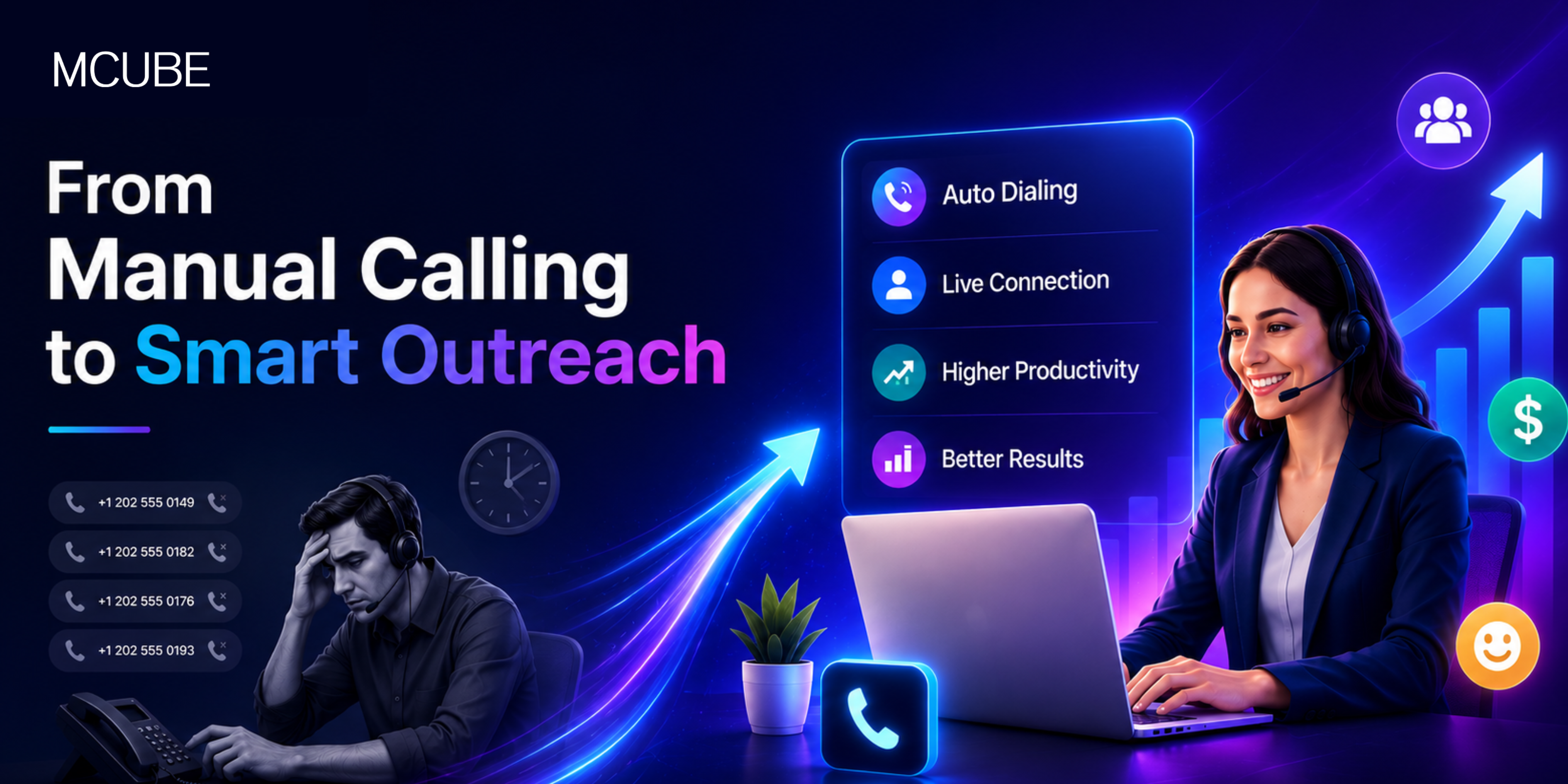
If your sales or support team is still dialing numbers manually, one by one, you’re risking a lot of productive hours. Manual dialing sounds simple enough, pick up the phone, dial, wait, and hope someone answers. But customer conversations are taking a drastic turn.
Sales teams need to follow up immediately, support teams need to deal with increasing call volumes and manual processes are not viable for any business. However, many of them still spend a considerable amount of time on dialing numbers and waiting for calls to connect or doing repetitive work instead of getting the real deal. With dozens of agents and hundreds of calls each day, however, the inefficiency adds up quickly. This is, after all, where autodialers have transformed the approach of outbound communication.
They are one of the most effective tools that businesses nowadays prefer to use for their outbound teams, because they are solving a practical concern: increasing customer interactions faster without hiring many agents. The automation of dialing can help to increase agent productivity, minimize idle time and streamline calling workflows.
Power dialers and predictive dialers help teams to operate more efficiently without compromising human interaction or rushed calls. This is why they are so desirable for businesses that choose from several different kinds of autodialers.
What is an Autodialer?
An autodialer is a calling system that dials phone numbers from a predefined contact list intelligently and connects answered calls to available agents. Instead of manually entering numbers one by one, agents can focus entirely on customer conversations, contributing to productivity.
This eliminates a significant responsibility of the repetitive tasks involved in customer support, collections and follow-up tasks for businesses that rely on outbound sales, customer support or follow-ups. It also supports teams to ensure consistency in their outreach efforts.
There are various kinds of autodialers according to the business requirement. Some are better for having agents control the conversation, while others could be ideal for scaling call volume. There are basically two types of modern auto dialers: Power Dialers and Predictive Dialers. They are different, they follow different strategies, they are for different sizes of teams, and they are for different campaign purposes. By knowing the difference, you can select the one that best fits your needs.
Power Dialer: Faster Calls with Better Agent Control
The power dialer is simple to use: One call to each agent. The moment an agent finishes dealing with a customer, the system automatically dials the following number on the list, without waiting for any human intervention.
- Automatic sequential dialing.
- Minimal idle time between calls.
- CRM integration for quick customer context.
- Call recording and monitoring.
- Better control over customer conversations.
This might not sound revolutionary, but think about the amount of time agents typically waste between calls, updating notes, scrolling to the next contact, and misdialing. A power dialer eliminates all of that.
The power dialer is effective due to the balance between speed and personalization. Agents are still able to process one call at a time, providing them with enough context to engage customers naturally without sacrificing productivity they spend every day.
However, if conversation quality is the ultimate objective, power dialer might be the best option for sales teams, follow-up campaigns, lead nurturing, and customer engagement activities. Spending less time on manual dialing means agents have more time to grasp customer sentiment and foster positive interactions.
Predictive Dialer: Maximizing Agent Talk Time
A predictive dialer works differently. Instead of waiting for one call to end before dialing the next, it takes help from the algorithms to dial multiple numbers at a time. It predicts agent availability and routes a live call to the agent the moment someone picks up. This significantly increases agent talk time and reduces the waiting period between conversations.
- Simultaneous dialing of multiple numbers
- AI-based agent availability prediction
- Increased agent talk time
- Automated call routing to available agents
- High-volume outbound campaign management
Predictive dialers are designed for businesses that manage high-volume outbound campaigns. Think of collections, surveys, appointment reminders, or large-scale lead follow-ups. When your goal is to reach as many people as possible in the shortest time, a predictive dialer is hard to beat.
The result? Agents are almost always on a live call. Idle time drops dramatically.
At the same time, businesses focus on predictive dialing strategies, maintain compliance standards, and provide a smooth customer experience rather than creating rushed or disconnected interactions.
Power Dialer vs Predictive Dialer: Which One Fits Your Business?
Both dialers boost productivity, but they aren’t interchangeable. Here’s a straightforward way to think about it:
| Factor | Power Dialer | Predictive Dialer |
|---|---|---|
| Calling Style | Dials one number at a time for each agent | Dials multiple numbers simultaneously based on agent availability |
| Best For | Warm leads, consultative sales, follow-ups, relationship-driven conversations | Large outbound campaigns, cold calling, bulk outreach |
| Agent Experience | Gives agents time to prepare before every conversation | Maximizes talk time with minimal waiting between calls |
| Personalization Level | High; supports more natural and contextual conversations | Moderate; focuses more on speed and scale |
| Ideal Team Size | Small to mid-sized teams | Larger teams with multiple active agents |
| Primary Goal | Better engagement and controlled conversations | Higher call volumes and maximum agent utilization |
| Risk of Dropped Calls | Very low | Can increase if agent availability is limited |
| Business Use Case | Lead nurturing, demos, customer relationship building | Telemarketing, collections, large-scale customer outreach |
| Choose When | Conversation quality matters more than call quantity | Speed, scale, and campaign volume are top priorities |
How MCUBE Autodialer Helps Businesses Improve Productivity
Modern outbound communication isn’t just about automated calling. In addition, with the business to meet the level of productivity, they need to have visibility into team performance, lead tracking, campaign monitoring, and smooth communication process.
MCUBE offers autodialer solutions that can enhance agent productivity and simplify outbound processes for businesses. Teams can save time on repetitive dialing tasks and have more time for customer interaction by automating repetitive calls.
MCUBE’s autodialer feature helps accelerate follow-up, cut down agent idle time and manage leads. Integrated with cloud telephony and CRM applications, the companies can streamline the flow of business communication and monitor customer interactions more efficiently.
Real-time analytics, call monitoring, live dashboards and campaign tracking are also available to help managers track performance and tweak outbound strategies accordingly.
Practical Impact: Metrics That Matter
The difference an autodialer makes is clear in the numbers. Teams using autodialers typically see:
- 2x to 4x more calls per agent per hour compared to manual dialing
- A significant drop in idle time, in some cases from 40% down to under 10%
- The system skips busy lines, voicemails, and disconnected numbers automatically, which leads to higher conversion rates.
- CRM-integrated call logs and disposition tagging helps improve conversion tracking.
These aren’t marginal gains. This level of efficiency directly correlates to additional pipelines. The ultimate result for a team involves more closed deals and cost savings per contact that calls thousands of times per week.
Conclusion
Outbound communication is no longer just about making more calls. It is about creating faster, more organized, and more productive customer interactions.
Autodialers can streamline workflows and boost agent talk time, enhancing the efficiency of business operations. Power Dialers emphasize personalized dialing speed, whereas, predictive dialers are utilized in high volume dialing for an organization to work more efficiently.
Businesses must be equipped with communication systems that will help them meet the ever-increasing demands and expectations of their customers and help them remain productive. Businesses that are investing in intelligent calling workflows now are laying the groundwork for future expansion and success.