
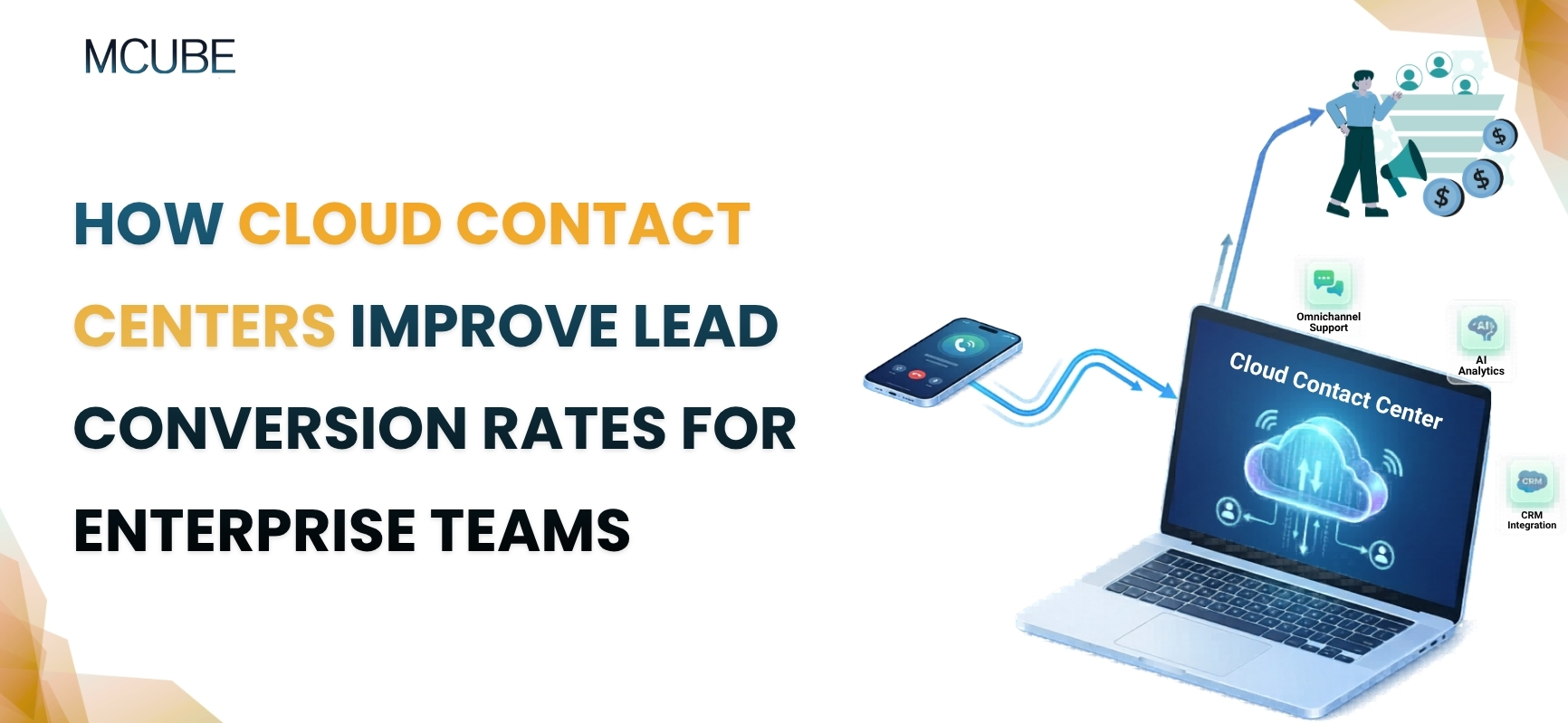
Enterprise sales teams no longer struggle with lead generation. The highly challenging part for them is the lead conversion.
The high-intent prospects come in through multiple channels, including ads, calls, forms, and referrals. Then, where do the conversions drop? The conversion rates will lag behind when the response times lag, follow-ups break, or the conversation lacks context. At scale, these gaps don’t look dramatic but quietly reduce pipeline efficiency and revenue outcomes.
This is where a cloud-based contact center solution can make a measurable difference. It doesn’t just manage the communication but fixes the exact points where the enterprise conversion funnels break.
In this blog, let’s examine how a cloud contact center solution improves lead conversion rates for enterprise teams by fixing these exact gaps. It focuses on four key areas:
- Faster response and structured follow-ups
- Context-driven conversations
- Handling high call volumes without loss
- Visibility and workflow control across teams
It also highlights how specific capabilities within an enterprise cloud contact center software directly impact conversion outcomes.
Let’s break this down clearly.
Why Lead Conversion Fails in Enterprise Sales Environments
Most enterprise teams already have strong lead generation engines. The real issue lies in execution after the lead is captured.
Here’s where conversion typically breaks:
| Conversion Gap | What Happens in Practice | Impact on Conversion |
|---|---|---|
| Delayed First Response | Leads are contacted hours or days after the inquiry | Drop in interest and lower first-contact conversion |
| Unstructured Follow-Ups | Follow-ups depend on individual agents instead of a system | Leads are missed or engaged inconsistently |
| Lack of Conversation Context | Agents restart conversations without prior interaction history | Reduced trust and slower decision-making |
| High Call Volume Overload | Teams cannot handle spikes in inbound or outbound calls | Missed opportunities and lost leads |
| Fragmented Communication Systems | Data is spread across tools with no unified view | Poor coordination and inefficient engagement |
How Faster Response Time Improves Lead Conversion
Whether an opportunity advances or fails is frequently determined by the initial engagement with a lead. Intent declines as response time rises.
A cloud-based contact center guarantees prompt handling of incoming questions and quicker outgoing connections. Calls are routed instantly, and sales teams can connect with leads while interest is still active.
Instead of relying on manual assignment or availability checks, the system guarantees that every lead is engaged at the right moment. This directly impacts and improves first-contact conversion rates and reduces lead drop-offs.
How Structured Follow-Ups Increase Conversion Rates
Several touchpoints are involved in enterprise sales cycles. Follow-ups become erratic and challenging to monitor in the absence of a clear framework.
For sales teams, a cloud contact center system offers organized workflows that guarantee leads are neither overlooked nor postponed. Instead of relying on individual effort, follow-ups are planned, monitored, and carried out according to predetermined logic.
A predictable interaction pattern is produced by this constancy. Sales staff keep up the pace throughout the funnel and promptly communicate with leads. More prospects consequently progress from initial curiosity to ultimate conversion.
How Context-Driven Conversations Improve Deal Outcomes
Conversion depends not just on speed, but on relevance. Conversations grow monotonous and ineffective when agents are unable to see past exchanges. Decision-making is slowed, and trust is diminished as a result.
Agents can view the entire conversation history thanks to the centralization of interaction data by business cloud contact center software. Each call builds upon the one before it. The quality of engagement is enhanced by this continuity. Sales teams are better able to address particular issues, provide context, and steer the conversation in the direction of resolution.
How Cloud Contact Centers Handle High Call Volumes Without Losing Leads
Enterprise demand often comes in waves: campaign launches, peak seasons, or product rollouts. Without the right infrastructure, high call volumes result in missed opportunities.
A cloud call center solution for high call volumes ensures that incoming and outgoing communication is managed efficiently. Calls are distributed intelligently, queues are handled systematically, and no inquiry goes unanswered due to capacity constraints. This helps enterprises to scale communication without compromising on response quality, which directly impacts conversion rates.
How Communication Capabilities Improve Lead Conversion in Practice
Beyond core functionality, specific capabilities within a modern cloud contact center platform directly strengthen different stages of the conversion funnel. These capabilities ensure that leads are captured, engaged, and converted without gaps.
- Inbound Communication Improves Lead Capture and Routing
Inbound communication determines how effectively high-intent leads enter your funnel. When a prospect reaches out, the experience needs to be immediate, relevant, and frictionless.
A modern cloud-driven contact center setup ensures that every inbound interaction is structured and efficiently handled. Instead of routing all calls through a generic flow, the system directs each inquiry based on intent and availability.
Key capabilities that enable this include:
- Intelligent call flows that guide prospects to the right team without unnecessary steps
- Dedicated business numbers that make it easier for leads to connect with your organization
- Automated response mechanisms that capture and respond to missed interactions instantly
- Context-aware routing that aligns each inquiry with the most suitable agent
- Traffic handling systems that maintain response quality even during peak demand
- Continuity in conversations by reconnecting repeat callers with familiar agents
- Built-in call tracking that helps teams review and refine how conversations are handled
Example:
A prospect calling for pricing gets routed directly to a sales specialist instead of a generic queue. This reduces friction, shortens conversation time, and increases the likelihood of conversion.
- Outbound Communication and Campaigns Improve Lead Engagement
Outbound engagement plays a critical role in moving leads through the funnel. Without a structured system, follow-ups become inconsistent and dependent on individual effort.
An advanced contact center platform brings discipline and scalability to outbound communication. It ensures that every lead is engaged at the right time, through the right channel, with the right context.
Core capabilities include:
- Automated calling workflows that help teams connect with more leads in less time
- Direct calling options within existing systems to reduce delays in outreach
- Scalable outreach methods to engage large sets of leads simultaneously
- Structured campaign execution that ensures every lead is followed up on systematically
- Built-in re-engagement logic to revisit leads that did not respond initially
- Smart allocation of leads across teams based on predefined priorities
- Verified outbound identity that increases the likelihood of calls being answered
Example:
Leads who do not respond on the first attempt are automatically re-engaged through structured campaign workflows. This improves connection rates and increases the chances of conversion without additional manual effort.
- Messaging and Omnichannel Interaction Improve Conversion Consistency
Enterprise buyers rarely rely on a single communication channel. They move between messaging, calls, and other touchpoints throughout their decision journey.
A unified communication setup ensures that these interactions remain connected and consistent. It allows teams to engage leads seamlessly, without losing context across channels.
Important capabilities include:
- Direct messaging channels that allow quick and convenient engagement
- Conversational platforms that support real-time, two-way communication
- A centralized interface where all interactions can be managed together
- Complete visibility into past conversations across channels
- Predefined response formats that help maintain consistency and speed
- End-to-end tracking of interactions, regardless of the channel used
Example:
A lead who starts a conversation on WhatsApp and later calls the sales team does not need to repeat information. The agent has full visibility into previous interactions, making the conversation more relevant and efficient.
- AI and Automation Improve Follow-Through and Efficiency
Manual processes often create delays, inconsistencies, and missed opportunities in the conversion journey. Automation addresses these gaps by ensuring that every interaction and follow-up happens on time.
AI and workflow automation bring consistency to how leads are handled, especially at scale.
Key capabilities include:
- Automated systems that handle initial queries without requiring agent intervention
- Full capture of conversations to ensure nothing is missed or forgotten
- Quick summaries that help teams focus on what matters from each interaction
- Insight generation from conversations to identify patterns and opportunities
- Automated execution of next steps, such as follow-ups and task assignments
- Predefined rules that guide how interactions are routed and escalated
- Performance tracking that highlights areas for improvement across teams
Example:
After-hours questions are managed by an automated system, which also plans the sales team’s callbacks. In order to avoid possible drop-offs, this guarantees that leads are collected and engaged even beyond business hours.
Conclusion
Lead conversion in enterprise environments does not break at the top of the funnel. It breaks down communication. Delays in response, disconnected follow-ups, lack of context, and missed interactions reduce the effectiveness of even the strongest demand generation efforts. These are not isolated issues but systemic gaps that impact conversion at every stage.
An enterprise cloud contact center software addresses these gaps by bringing structure to how communication is handled. It ensures that inbound inquiries are routed correctly, outbound engagement is consistent, conversations remain connected across channels, and follow-ups happen without delay.
More significantly, it changes the emphasis from activity to results. Teams can concentrate on how well discussions advance leads rather than counting the number of calls made. Higher connection rates, better-quality conversations, and more consistent conversions are all benefits for sales teams. It results in improved pipeline performance for the company without raising operational complexity.
Increasing effort is not the way to improve conversion. It involves creating a system in which each interaction is pertinent, timely, and in line with the buyer’s journey. That is the role a well-implemented cloud contact center plays in enterprise growth. To see how this works in practice, explore how MCUBE helps enterprises streamline communication and improve lead conversion at scale.