
We will look into real data before we dive deep into call operations and cloud telephony.
We will look into real data before we dive deep into call operations and cloud telephony. In the past years, business call centers globally have spent between 60-70% of their total operational budget on labour alone. Infrastructure, licensing, maintenance, and telecom expenses are all included. Now, think about the average cost per call you spend on your business communication. And what happens when the call volume scales? The operational cost is just one part. Matching the customer expectations in the present day requires a well-built system without fail. Rapid resolution, minimal wait time, contextual continuity, low abandonment rates, and many more factors contribute to the CX, where businesses will have to scale their operational budget to prevent revenue leakage.
But is scaling the operational budget the only way to establish a calling structure? No, but most of the businesses attempt to increase the agent count or expand hardware capacity. Here lies the fundamental problem since those approaches expand the cost structure without correcting the structural inefficiencies. In this context, we talk about cloud telephony setup, a non-negotiable call ecosystem for modern businesses.
Let’s evaluate the cloud calling services in detail and learn how it optimizes the operational costs, bringing the best calling architecture.
Defining a Cloud Telephony Framework for Cost Efficiency
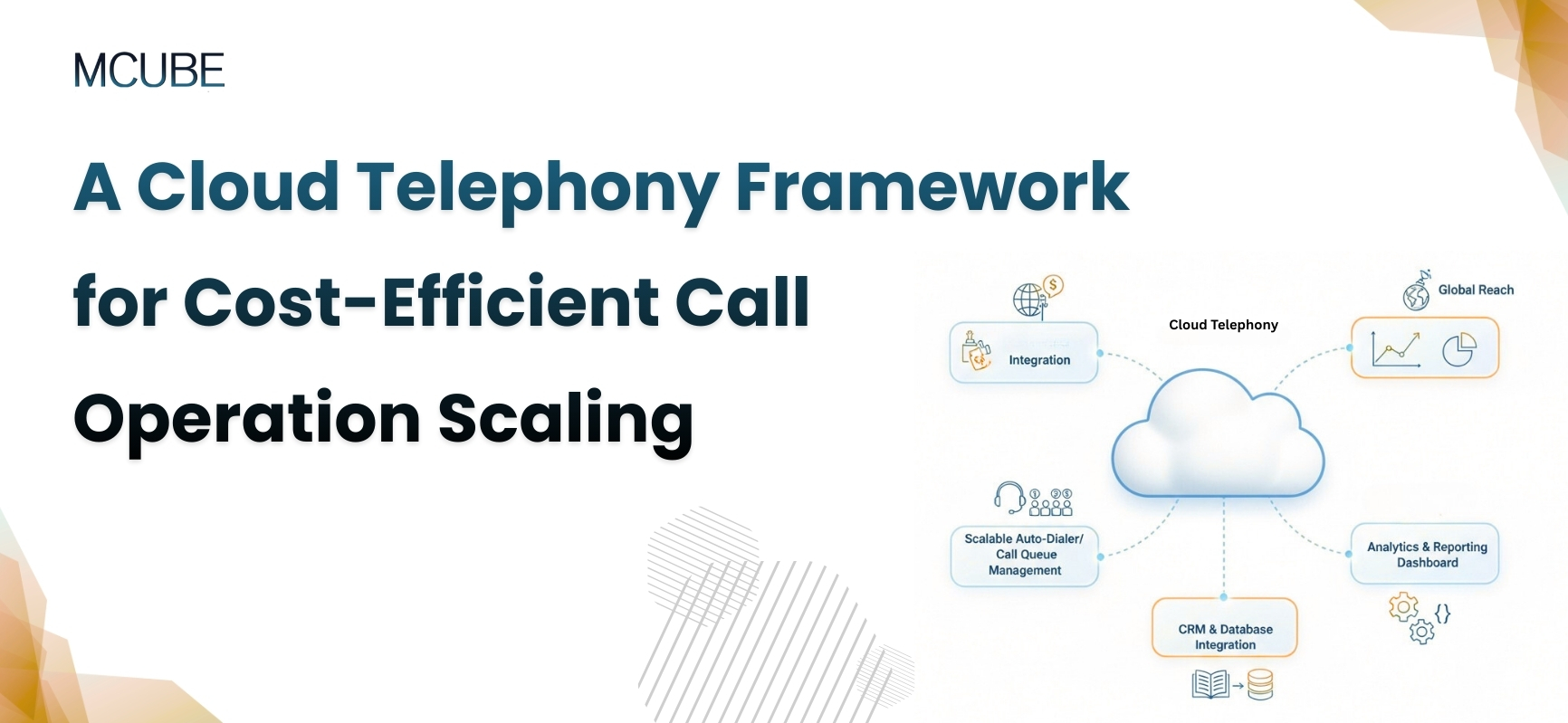
What is a cloud telephony framework? It is a structural redesign of call operations that replaces hardware reliance with the distributed infrastructure, integrates routing intelligence with business data, and embeds the automation directly into communication workflows. Now, the cloud telephony companies are adopting AI for orchestrating the inbound and outbound calling systems.
Let’s see the few components to define the cloud telephony framework:
- Elastic infrastructure scaling
- Intelligent call routing based on context and value
- Automation-driven volume optimization
- Complete analytics of the call journeys and cost visibility
Each component directly influences operational cost per interaction.
The Strategic Role of Call Routing in Reducing Cost Per Call
Are you wondering how call routing influences the cost of a call? Here’s an answer for you.
Static routing models assign the calls based on the availability or pre-defined skill groups without looking into the contextual complexity or revenue impact. A cloud telephony framework manages an inbound call to the IVR system, integrates the routing logic, and helps the calls reach the right agent or team at the right time. It can capture the caller’s interest with the menu options, and calls will be routed to the appropriate team with various distribution logics, including parallel, priority, sequential, or weightage-based. With the menu options, the system will help you prioritize high-value customers to match the inquiries to specialized agents and adjust the distribution patterns dynamically.
Along with IVR, AI-backed Voice Bots also help in lead qualification. Since the context and intent are already captured, only high-value leads or conversations reach the human agents. The repeated or routine queries can be resolved with self-service menus. Here you can see that call routing decisions parallelly impact the labour efficiency, a factor that constitutes the largest cost component in contact centers.
The operational research suggests that the routing can reduce the average call handling time to 20-30 % while increasing the first call resolution rates. As you know, the labour costs represent the majority of call center expenses, and even the marginal efficiency gains can translate into significant cost reduction at scale.
Call Automation in a Cloud Telephony Platform
Call automation within a cloud telephony software transforms both inbound and outbound operations into structured, cost-controlled workflows. When an inbound call enters the system, the cloud telephony platform will not treat it as a generic queue. The system will identify the intent and route the call using the distribution logic. Here, the system is filtering and working hand-in-hand with the agents and brings the best AX and CX possible.
The filtering efficiency and automation do not stop when the call ends. Post-call automation removes the manual follow-ups that may extend beyond the call work duration. In a unified cloud telephony platform, automated WhatsApp messages, SMS, RCS, ticket updates, or call back scheduling, etc., can be triggered instantly after an inbound interaction. So, the system will execute these actions programmatically, ensuring consistency.
If you are concerned about the manual customer outreach, the auto dialer services integrated within the cloud telephony framework can assist. They come in different dialing modes, including predictive, progressive, and preview, which can be customized for business requirements. With an auto dialer software, agents can be connected to live calls, filter invalid numbers, schedule auto retries, and make live call actions to barge in and whisper. A recent survey conducted among the MCUBE customers validated that they could increase their average talk time up to 30-40% compared to manual dialling systems.
Now, what if your customer didn’t pick up the call? The system can immediately send a contextual message in your preferred channel, whether it be WhatsApp, RCS, or SMS. Here, the financial implication becomes clear when inbound filtration reduces unnecessary agent load, and outbound automation increases productive engagement time.
Real-Time Analytics and Cost Governance in Cloud Telephony
Are your call journeys mapped to retrospective reporting? Managers review and analyze weekly or monthly performance summaries and attempt corrective action based on the historical patterns. This delays the intervention and allows inefficiencies to compound before correction. But cloud telephony systems give a comprehensive and immediate visibility into the metrics such as agent utilization, average handle time, service level adherence, abandonment rate, and queue length, the call distribution patterns, and mapping all call journeys. So whenever the performance deviates from acceptable thresholds, decision-makers can act instantly.
Key Advantages of Real-Time Visibility:
- Instant identification of queue congestion before abandonment rates spike
- Faster correction of rising average handle time
- Real-time workforce reallocation to prevent overstaffing or understaffing
- Monitoring of agent productivity and utilization levels
- Early detection of routing inefficiencies across call journeys
- Data-driven decision-making instead of assumption-driven adjustments
- Direct correlation between operational metrics and cost per interaction
Conclusion: Cost-Efficient Scaling Through Cloud Telephony
A fluid infrastructure, intelligent routing, call automation, and real-time analytics do not operate as isolated capabilities. They work as an integrated cost-control architecture that transforms the scaling of call operations within a cloud telephony framework. Agent effort is matched to call value and complexity through intelligent routing. The call automation reduces repetitive work and helps to improve productive engagement time. While these components are working together, scaling no longer demands a proportional increase in headcount or hardware. Cost-efficient scaling, therefore, depends less on expansion and more on structural design.
Now we know how a cloud telephony framework ensures that as call volume rises, profitability does not decline with it. If you want to discover more about cloud telephony and build a cost-efficient call flow or communication ecosystem for your business, connect at 1800 419 2202.