
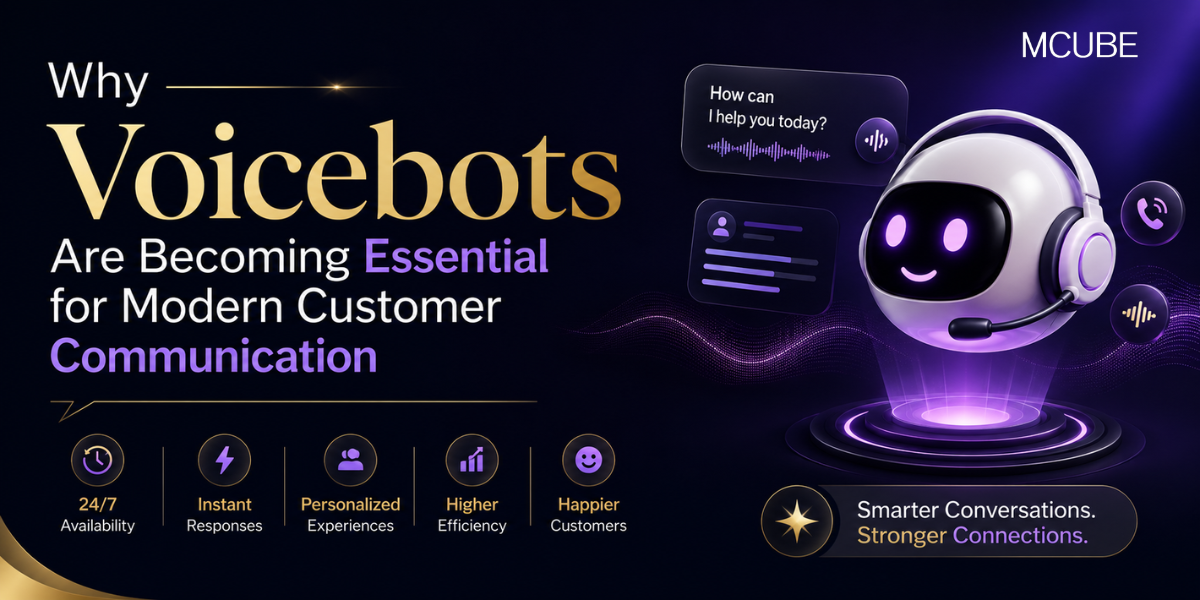
With the rapid transformation of business communication methods, customer expectations are also shifting faster. Customers nowadays don’t want to be kept on hold while calling your business number. They get easily frustrated with the long wait time, the same looping music, and the complicated phone menu.
This is why businesses started to reconsider the ways customer interaction could be simplified, with less frustration and more productivity. Voicebots are changing that equation. Powered by AI and Natural Language Processing (NLP), voicebots are not here to replace human connectivity but to work with them hand-in-hand to make the interaction seamless. This makes voicebots an important tool for handling repetitive queries, managing high-volume calls, and improving business communication with customers.
What Are Voicebots?
Voicebots are AI-powered systems that respond to customer interactions in real time just by understanding their spoken language. Unlike traditional IVR menus that only have a few fixed options to help the customers resolve queries faster, voicebots function by understanding the conversational language and the customer sentiment behind asking about anything, and respond in a natural, humanized way.
While interacting with customers, a voicebot:
- Converts spoken words into texts through Automatic Speech Recognition (ASR) in real time
- The Natural Language Processing (NLP) software helps them figure out the customer sentiment behind every spoken word
- Text-to-speech (TTS) delivers a response in a natural and humanized way, and not in a robotic way
- Some of the bots also integrate with your existing CRM to get clarity on every customer details when they call
AI voicebots are also employed in modern businesses for streamlining various customer interaction processes including:
- Appointment scheduling
- Call routing
- Order tracking
- Lead qualification
- Customer support
- FAQ handling
The goal is simple: To deliver smooth, simplified, and quick customer communication.
How Voicebots Are Improving Operational Efficiencies?
Your customer support team spends most of its time answering the same repetitive questions, which sometimes even leads to an increased call bounce rate due to the lack of time management. Voicebot helps reduce this workload by automating routine interactions.
This enables your support team to concentrate on:
- Complex customer issues
- Escalations
- Relationship-building conversations
- High-value support tasks
To businesses, the advantages are huge:
- Reduced support costs
- Better resource allocation
- Faster response times
- Better call handling capability.
Voicebots can process thousands of calls concurrently, without dropping any calls during high-demand periods or during the season.
This makes customer support far more scalable without constantly increasing the workforce.
How Voicebots Are Enhancing Customer Experience?
Speed is the most advantageous feature of a voicebot. Customers these days expect quick interactions, faster responses, and prompt answers. A voicebot can offer all of them without the need for any basic human intervention. While interacting with a voicebot, customers do not have to wait for an agent to pick up the call and start providing the basic information as long as their involvement is not required.
Voicebots are capable of creating a more consistent customer experience because they:
- Are available 24/7
- Quickly respond to queries
- Handle repetitive queries efficiently
- Are capable of providing multilingual support
This can significantly improve customer satisfaction for businesses handling large volumes of calls.
| Traditional Support | Voicebot Support |
|---|---|
| Long wait times | Instant responses |
| Limited working hours | 24/7 availability |
| High dependency on agents | Automated handling of routine queries |
| Repetitive customer interactions for agents | Faster and more efficient query resolution |
| Difficult to scale quickly during peak demand | Easily scalable to handle high call volumes |
| Higher operational costs | Lower cost per interaction |
| Inconsistent customer experience | Consistent and standardized responses |
| Limited simultaneous customer handling | Can manage multiple conversations at once |
Where the Real Change is Taking Place?
Voicebots are improving customer experience not only by answering every incoming call, but also by simplifying customer interactions in many ways across industries. Some of the remarkable contributions of voicebots are:
| Industry | Common Voicebot Applications |
|---|---|
| Healthcare | Appointment reminders, patient query handling, follow-up scheduling |
| Education | Admission inquiry management, student support, course information assistance |
| E-commerce | Order status updates, delivery tracking, return request handling |
| Banking and Finance | Balance inquiries, transaction assistance, customer verification support |
| Real Estate | Lead qualification, property inquiry handling, site visit scheduling |
Common Outcome: High volume and low complexity tasks that saves agent time and productivity alongside enhancing customer experience.
The General Business Case in Numbers
Real-time metrics help people understand how the voicebot is actually helping businesses achieve what they’re looking for.
| Metric | Traditional Call Centre | With Voicebots |
|---|---|---|
| Average Handle Time | 6–8 minutes | 1.5–3 minutes |
| Cost per Interaction | $6–$12 | $0.10–$1.00 |
| Availability | Business hours only | Round-the-clock |
| Scalability During Peak Demand | Limited by agent headcount | Virtually unlimited |
| Agent Burnout Risk | High due to repetitive queries | Reduced significantly |
| Response Consistency | Varies by agent | Consistent across all interactions |
| Concurrent Customer Handling | Limited | Can handle thousands simultaneously |
| Operational Efficiency | Resource-intensive | Highly automated and efficient |
The Right Augmentation of AI & Human Support
While voicebots can seamlessly handle routine queries and reduce the possibility of missing leads, they are not designed to replace human intervention entirely. The idea is not to be a substitute for human effort, but an augmented solution to make the process more efficient.
There are many situations businesses face every day, where a human intervention is required to resolve an issue with empathy, critical thinking, and proper analysis.
Customers dealing with sensitive issues or complex situations still prefer speaking with a real person.
To solve such complex scenarios, the most effective approach is usually a hybrid model, where after a certain point, the bot routes the call to the right agent or department.
In this setup:
- Voicebots manage repetitive and high-volume tasks
- Human agents handle complex or emotionally sensitive conversations
This creates a smoother experience for both customers and support teams.
Conclusion
Voicebots are not here to replace human effort and contribution in customer service, and the good part is, they are not even trying to. They are here to help businesses with faster and more efficient support that helps improve operational efficiency and create more convenient customer experiences. They deliver natural, human-like responses just by understanding the sentiment behind every customer query, and route calls efficiently when any issue demands human support. More importantly, they allow businesses to scale communication without compromising responsiveness.
AI-powered voice communication is no longer an option but a necessity for businesses as the customer expectation towards a seamless interaction is growing day by day. Voicebots are going to become a must-have tool for customer support in the near future, and companies that implement them strategically now will be well-placed to provide smooth customer interactions in the future.