
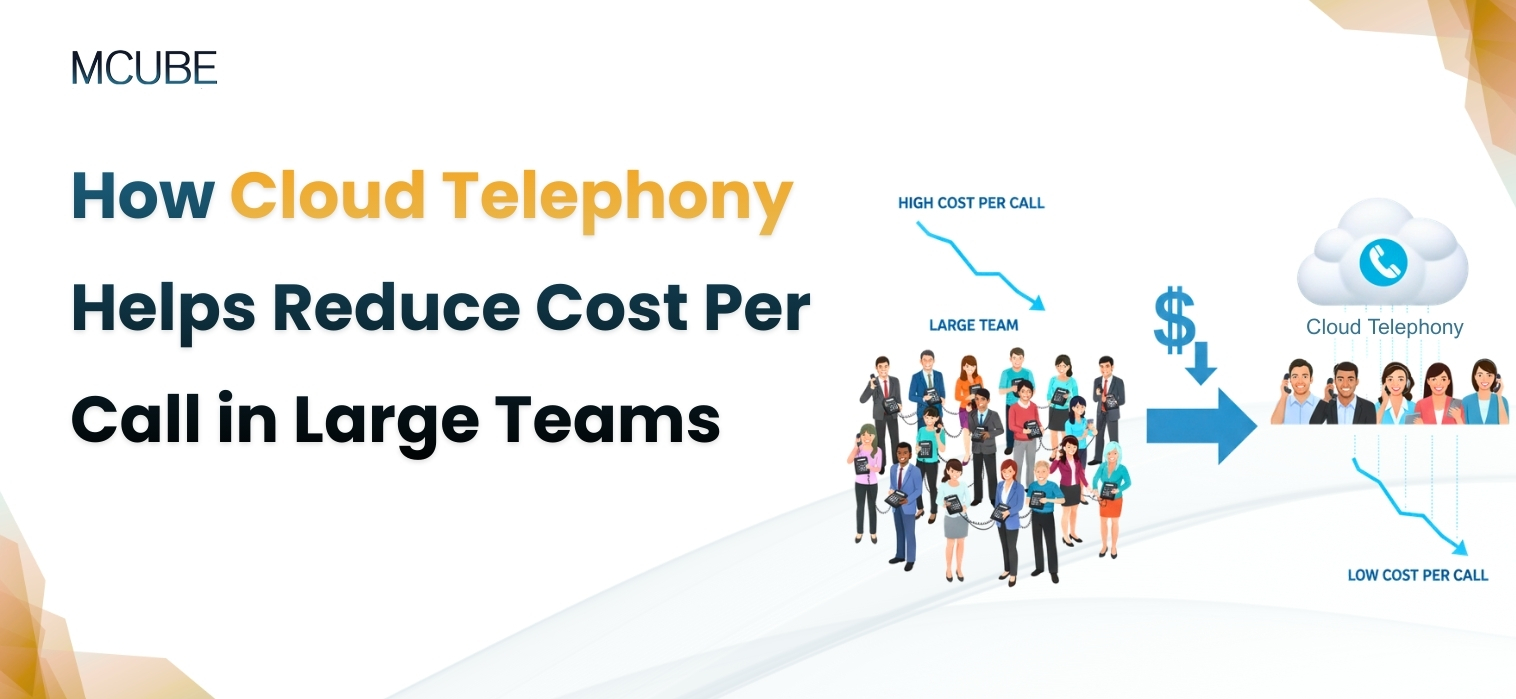
How can you figure out how much your business calls will cost? It can mean the difference between operational chaos and scalability in large sales and support teams. Only a small percentage of businesses examine the true question, while the majority are preoccupied with lead volume, agent headcount, and average handling time.
How much does each customer conversation actually cost us?
If you run a 50 or 100+ member calling team, the answer will be surprising and often uncomfortable. At this point, cloud telephony is not limited to a communication tool but starts becoming a cost-optimization engine. How does it work like a cost-optimizing engine for business? Let’s break down how it reduces cost per call, where traditional systems leak money, and why a structured call management system is inevitable for large calling teams.
How Cloud Telephony Helps You Understand True Cost Per Call
Many businesses calculate the cost of their business calls by two factors: agent salaries and the number of calls they handle. But does this cover all the costs associated? No, it actually misses several hidden factors which can increase the costs in large teams, such as;
These include:
- Agent idle time between calls
- Repeat calls caused by misrouting or incomplete resolutions
- Manual dialing and delayed CRM updates
- Hardware maintenance and IT overhead
- Supervisory monitoring and auditing
- Extended onboarding and training
A cloud telephony for business solution addresses these inefficiencies with centralized control and actionable insights. By consolidating call data, automating repetitive tasks, and tracking performance, decision makers can get a clear view of the true cost of each customer interaction.
With these insights, the calling teams can:
- Identify and eliminate bottlenecks in call handling
- Optimize call routing to reduce repeated interactions
- Reduce administrative overload for the agent
- Streamline training and onboarding processes
Instead of relying on vague estimates, teams using cloud telephony can make data-driven decisions that directly reduce operational costs and improve overall efficiency.
Reducing Infrastructure Costs with Cloud Telephony
The infrastructure requirements of the traditional phone systems increase the cost of business communication to a great extent. The on-premise PBX hardware, multiple phone lines, wiring, maintenance contracts, and IT support all add up. For large teams, scaling often means more equipment and higher expenses, which directly raises the cost per call. These physical constraints can be eliminated by switching to cloud telephony for business communication. Teams can add users and locations without buying or installing new equipment. The key benefits include:
- No need for PBX hardware or extra phone lines
- Less time spent on maintenance and support
- Ability to scale instantly without additional wiring
- Easy updates and feature rollout
Cloud telephony helps to reduce the cost per call and scale their operations smoothly by removing these fixed costs.
Boosting Agent Productivity with Cloud Telephony
For businesses of any size handling customer communication, agent productivity is one of the biggest factors affecting per-call cost. Agents often spend significant time on manual tasks such as dialling numbers, waiting for busy lines, or updating CRM systems after each call. Every minute lost in these processes increases costs and reduces the number of customer interactions an agent can handle.
A cloud telephony for business setup streamlines all these tasks, helping the agents to focus on actual conversations rather than administrative work. The key productivity benefits include:
- Automated dialling: Connects agents to live numbers, eliminating wasted time
- CRM updates: Call details are logged automatically without manual entry
- Call filtering: Disconnected or invalid numbers are removed from campaigns
- Follow-up scheduling: Automatic reminders ensure no customer falls through the cracks
By mitigating agent idle time and manual work, cloud telephony helps agents handle more calls efficiently. This improves productivity but also lowers the overall cost per connected call, making large teams more effective without adding more staff.
Reducing Repeat Calls with Cloud Telephony
Repeated calls are one of the drivers of call costs in business. Moreover, it will frustrate the customers. When issues aren’t resolved on the first call, teams end up handling the same interaction multiple times.
Cloud telephony for business solves this by:
- Routing calls to the right agent with intelligent IVR
- Matching issues to the best agent through skill-based assignment
- Giving agents context via CRM integration
- Prioritizing urgent calls in queues
Fewer repeat calls mean lower cost per call and a smoother customer experience.
Cloud Telephony for Maximum Efficiency and Savings
Cloud telephony goes beyond connecting calls and optimizes the entire calling operation for large teams. Key ways it reduces cost per include:
- Improved control: Managers may more effectively direct agents with the use of automated recordings, call monitoring, and real-time dashboards.
- Scalable teams: Instantaneously add users and onboard remote agents without the need for additional hardware or expenses.
- Outbound call automation: Lead prioritization, automated follow-ups, and predictive dialing boost connection rates and cut down on squandered calls.
- Data-driven optimization: By identifying bottlenecks, enhancing routing, and focusing agent training, call data insights can increase efficiency over time.
By combining automation, scalability, and actionable insights, cloud telephony ensures large teams handle more calls effectively while lowering per-call costs.
Conclusion
In large teams, lowering the cost per call does not mean reducing customer contacts or staffing levels. It’s all about making the calling process as efficient as possible. Cloud telephony for business changes the way large teams work by removing hidden inefficiencies and infrastructure expenses, increasing agent productivity, decreasing repetitive calls, and utilizing automation and real-time data.
Cloud telephony makes every interaction productive, efficient, and economical by streamlining call administration, enhancing oversight, and facilitating data-driven decision-making. Adopting a cloud telephony platform offers more than just an improvement in communication for businesses that handle large call volumes. It is a calculated investment in scalability, efficiency, and quantifiable cost savings. If you want to discover more about cloud telephony, reach out to MCUBE Cloud Telephony at 1800 419 2202.