
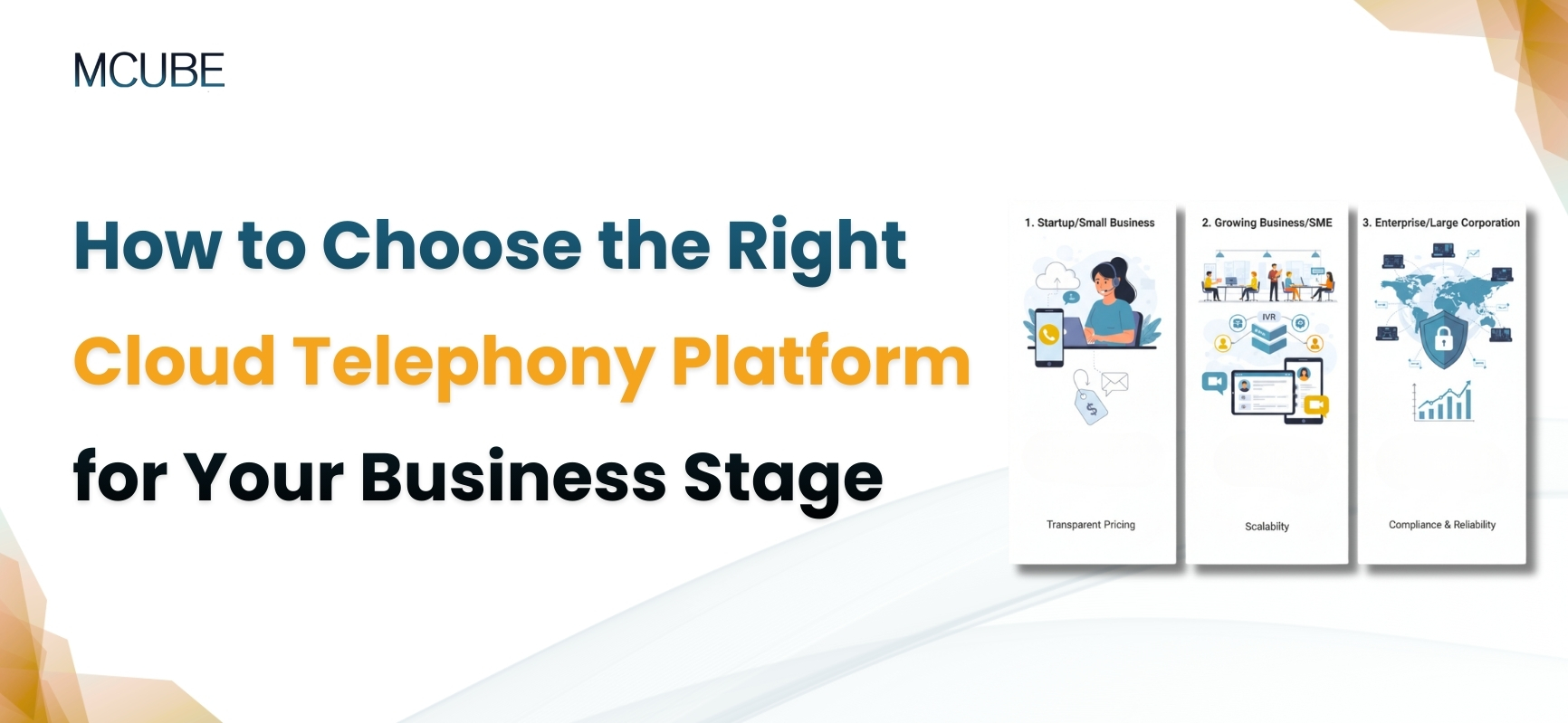
Not every business needs the same communication stack. A 5-user startup trying to close the first 100 customers has very different needs from a 200-seat support team handling thousands of inbound queries every day. Mistakes start here.
Choosing the right cloud telephony setup for your business is not about features alone. Businesses should consider timing, scale, control, the depth of automation, and how communication supports revenue at their current stage. Let’s break this down stage by stage.
Cloud Telephony Explained
Before we dive in, let’s have a look at cloud telephony in detail. At its core, cloud telephony helps you shift your business communication system from a hardware setup to a cloud-based solution; your entire calling infrastructure runs on cloud servers.
This is the technical definition, but what is the functional explanation of cloud telephony software?
It gives businesses virtual numbers that can be routed across teams, locations, departments, etc. Tools like IVR help the incoming calls reach the right agent or department and centralize your incoming call management. For outbound, the system also works with auto dialer, click-to-call, etc., to orchestrate the calls properly. The best part is that all these call journeys will be tracked and recorded. The modern cloud communication is backed by AI and tools such as AI voice bots, and post-call analysis is gaining popularity. They also seamlessly integrate with CRMs, marketing tools, etc. So altogether, it directly influences the lead conversion, CX, response time, agent productivity, and even revenue visibility. When implemented effectively, especially cloud telephony in call center environments, it can act as a performance engine more than a communication tool.
How to Choose a Cloud Telephony Platform
Before choosing a suitable cloud telephony platform, you need clarity on what you are actually evaluating. All cloud telephony software is not built the same. While some focus on heavy operations, others emphasize simplicity. So the right choice for your business depends on business size, call volume, and the complexity of the communication process you are dealing with.
Given below are a few factors you can consider when investing in cloud communication.
- Scalability
- Call management capabilities
- Integration with business tools
- Automation and reporting
- Infrastructure and reliability
Once these fundamentals are discussed clearly, the decision becomes easier and more efficient.
Choosing A Cloud Telephony Platform for Startups
For startups, communication is more about speed and control than scale. When the lead count is limited and budgets are tight, every missed call can directly affect the revenue. Since most startups operate with small teams, sales reps or even founders handle calls themselves. Here, a right cloud telephony setup can help to:
- Shift from personal numbers to a centralized business number
- Route calls with IVR
- Enable cloud calling
- Track and record all conversations
- Integrate with CRM
Startups with small call volumes don’t require a complex automation setting or high-concurrency infrastructure. Instead, the focus should be on the ease of setup, transparent pricing, and the ability to scale as the team grows.
Best Cloud Telephony Approach for SMBs
For small-to-medium scale businesses, the communication will not be limited to answering the calls but should also manage the performance. With a structured sales team, dedicated support function, campaign-driven lead generation, etc., you will be orchestrating different teams. The call volumes will increase, follow-ups can multiply, and you need complete visibility into the outcome. At this stage, cloud telephony can help you with:
- Progressive, preview, and predictive dialers for outbound teams
- Intelligent call distribution based on the agent’s skill or the lead source
- Comprehensive dashboard for performance monitoring
- Automated workflow for missed call alerts, follow-up triggers, etc.
- CRM integration
- Unified cloud communications across voice and messaging channels
At this stage, your team cannot afford manual tracking or fragmented systems. Investing in the right cloud telephony can help to improve the response time, increase talk-time efficiency without adding operational complexity.
Selecting Cloud Telephony for Large Enterprises
Communication itself becomes the infrastructure for large enterprises. The high call volumes, call complexities, compliance, and performance across teams and locations are all matters.
As a large enterprise, you may be running:
- Dedicated inbound and outbound teams
- Multi-city or multi-branch operations
- 24/7 support environments
- Strict service-level agreements
In this scenario, basic cloud calling capabilities are not enough. The focus shifts to scalability, reliability, and intelligence as well. When evaluating a cloud telephony platform for enterprise use, you should prioritize:
- High concurrency handling
- Multi-level IVR with advanced routing logic
- Skill-based call distribution
- Real-time monitoring dashboards and wallboards
- Supervisor tools (live monitoring, whisper, barge-in)
- Queue management and SLA tracking
- AI and automation tools
- Infrastructure redundancy and uptime guarantees
Along with these data security standards, custom API integrations, etc., also matter, but not all cloud telephony companies are equipped to support operational complexity. Some platforms scale the users, while a few scale infrastructure and intelligence. So the key question is, can the platform you choose handle the current call load, future growth, without compromising the performance, visibility, or compliance?
Conclusion
At present, many businesses don’t outgrow their market first; they outgrow their systems. In most cases, the communication cracks. While a startup can survive on manual follow-ups and basic cloud calling, a medium-sized business cannot. An enterprise cannot even afford a few minutes of downtime. So when the complexity compounds, so should your communication infrastructure.
In such cases, choosing a cloud telephony platform becomes an operational decision, and the right cloud telephony service provider should match your call volume, process maturity, and growth trajectory, and not just budget.
So the real question is which platform will still support you two years from now without forcing you to rebuild the workflows.
Modern cloud communications is at the intersection of sales velocity, CX, and operational visibility. Whether you are implementing a simple routing or full-scale cloud telephony for call center environments, the decision should be made with long-term architecture in mind.