
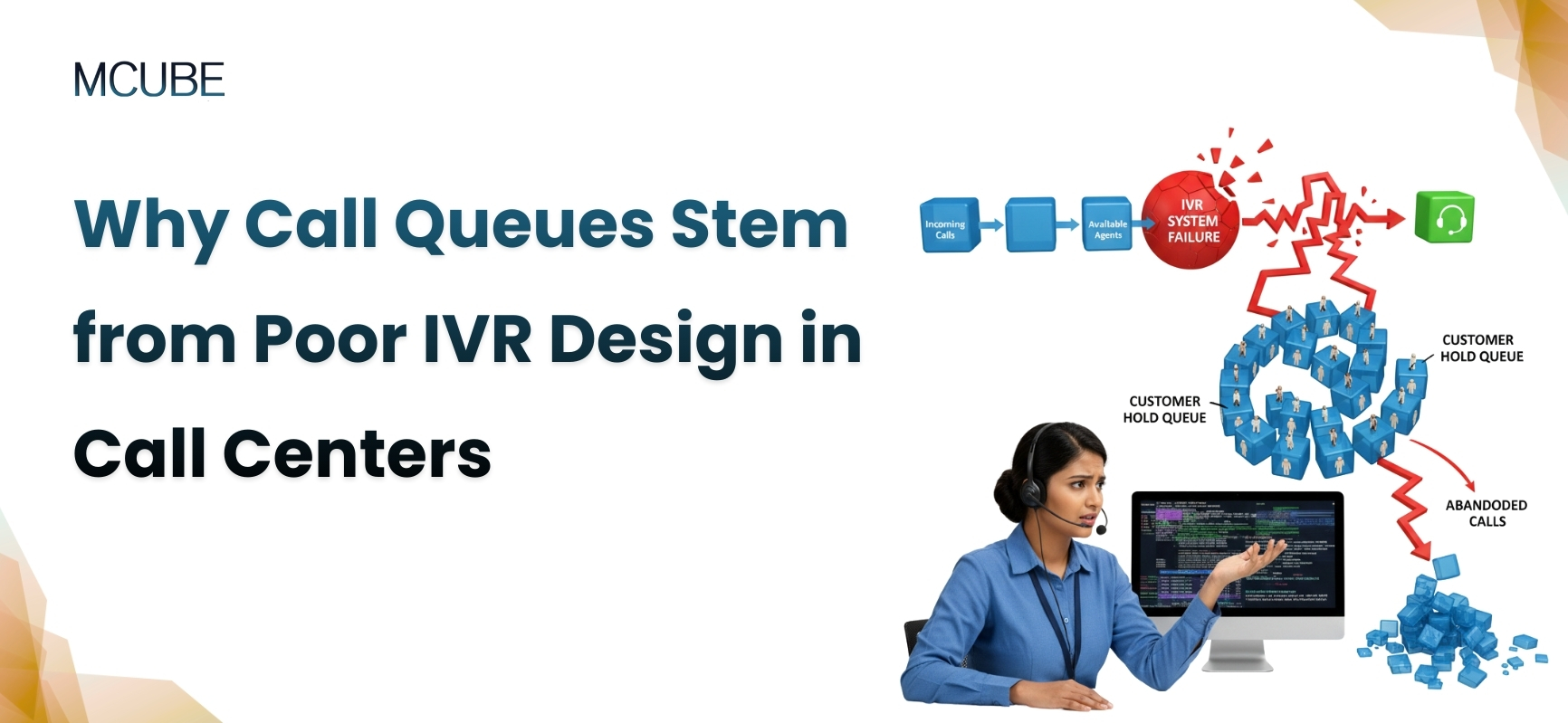
Let’s start with the basics. Why do incoming calls come to your business number? They might be a new customer seeking your product or solutions, or an existing customer looking for support. When these call volumes started to spike, businesses started adopting IVR platforms for inbound call management. With the help of an IVR platform, these incoming calls coming through your virtual number or toll-free number will be routed to the right team based on the caller’s requirement.
And if you still experience long call queues, that is no longer a volume issue but an IVR design failure.
When your customer endlessly waits to connect with the right agent, the issue with your system begins before the caller ever reaches a human. Let’s make it clear. A poorly designed IVR will not help you handle the calls effectively, instead creating friction, misrouting intent, overloading your agents, and draining your operational efficiency.
Now, we will discuss IVR in detail, how to design, set up, and implement an IVR for your call center.
What is an IVR?
Before we go deeper, let’s clarify the foundation, what IVR really is.
An Interactive Voice Response (IVR) system is a technology that helps businesses manage their inbound calls through a single business number, which can be routed to different departments. All customers calling this number are greeted with a welcome message, without the need for a human agent. Here, the IVR acts as a virtual receptionist, providing a recorded menu to collect the caller’s input. The caller can use either keypad or voice inputs to reach the right agent or achieve their desired outcome.
IVR helps reduce call queues and agent dependency and workload, ensuring that calls are routed to agents only when required or requested by the customer.
Why Call Center Struggles with Queues
Now that we understand what an IVR is, let’s focus on the real issue: call queues in call centers.
Long queues are often attributed to high call volumes or limited staffing. If you respond to the queue pressure by hiring more agents or extending the hours, you treat the symptom, not the cause.
If you don’t have an IVR system to manage the inbound calls, the first step is to get one. Now, how should your IVR work? It should classify the calls, capture the intent, and route them to the right agent or department if callers didn’t reach the outcome using self-service options.
Adding more agents or extending your working hours is not the right solution for call queue issues in call centers.
Common IVR Design Mistakes in Call Centers
- IVR is built only for business
Many IVR menus reflect the internal departments instead of customer intent. If you merely provide options like “Press 1 for sales, Press 2 for accounts,” etc, you are just allowing the callers to assume how your business works. All callers will not be aware, and they think of problems, not departments. When your IVR forces the internal logic to external users, misrouting will be common, and call queues will grow where they are not meant to be.
- Static menus for a dynamic call environment
Your customer intent is not static, yet many IVR systems are. Consider an example. Your existing customer is calling about an unresolved issue and getting treated the same way as a first-time inquiry. Here, an adaptive logic is absent, and IVR will repeatedly send the callers through generic paths, raising the handling time and queue congestion. Modern automated call routing using IVR must respond to context.
- Over-reliance on rigid navigation
Sometimes the problem with the IVR platform is not the keypad inputs but the rigidity. When callers struggle to find their issue in the predefined menu, they will be forcefully fitted into the wrong ones, resulting in wrong routings. Either they choose randomly or wait for an agent. Such cases inflate the queues unnecessarily, and IVR starts to become a cause for call traffic in your system.
How Bad IVR Design Turns into Call Queues
Many IVR platforms in India emphasize heavily on the deployment speed, basic automation, and fail to invest in call flow intelligence. The common gaps include the lack of personalization, homogeneous routing logic for all, weak CRM integrations, and minimal post-call feedback loops. If your business is scaling nationally, these limitations will start to appear peripherally fast. We have seen examples of call centers solutions collapsing even with 200+ agents, since their IVR system was not adapted to the complexities.
Now, what is the result of a wrongly implemented IVR?
- Calls land with the wrong agents
- Agents transfer calls multiple times
- Average handling time increases
- Agent availability drops
- Queues lengthen across departments
Businesses should pay close attention while designing an IVR to reduce their queues, manage and attend to all calls, improve first call resolution, and reduce handling times.
How to Design an IVR Call Flow
The most rewarding IVR strategies for a call center for business are preventive, instead of being reactive.
- Intent-led routing
Calls should be routed based on the purpose of their call, not who handles that function internally. This helps to reduce the transfers, call handling time, and helps to distribute the queues evenly.
- Context-aware call flows
When IVR is integrated with CRM and call history, it helps in call prioritization,n where high-value customers, repeated callers, or unresolved tickets can be segregated.
- Frequent IVR optimization
IVR is not a rigid setup; it should be monitored and changed based on your queue times, routing accuracy, abandonment rates, etc. Figure out what works and what not, especially in seasonal spikes. Collaborate with the right IVR service provider to get the best results possible.
Conclusion
Demand is rarely the only factor causing call waits. They result from shallow routing logic, fragmented call flows, and IVR systems that were built to exist rather than function in the majority of contact centers. Inefficiencies spread silently throughout the business when IVR is viewed as a basic necessity rather than a strategic layer.
A well-designed IVR for a call center solution does more than greet callers or deflect traffic. It handles agent load, accurately captures intent, adjusts to context, and makes sure calls go to the correct place without needless hassle. Instead of handling queues after the damage is done, this keeps them from starting in the first place.
At this point, selecting the best IVR service provider becomes crucial. Not every IVR platform is designed to evolve with increasing call volumes, changing consumer behavior, or intricate business processes. The distinction is not in the quantity of menu selections available, but rather in the system’s clever design, integration, and ongoing optimization.
For call centers focused on efficiency, experience, and long-term scalability, fixing call queues is not about adding more agents or extending hours. It starts with fixing the IVR.