
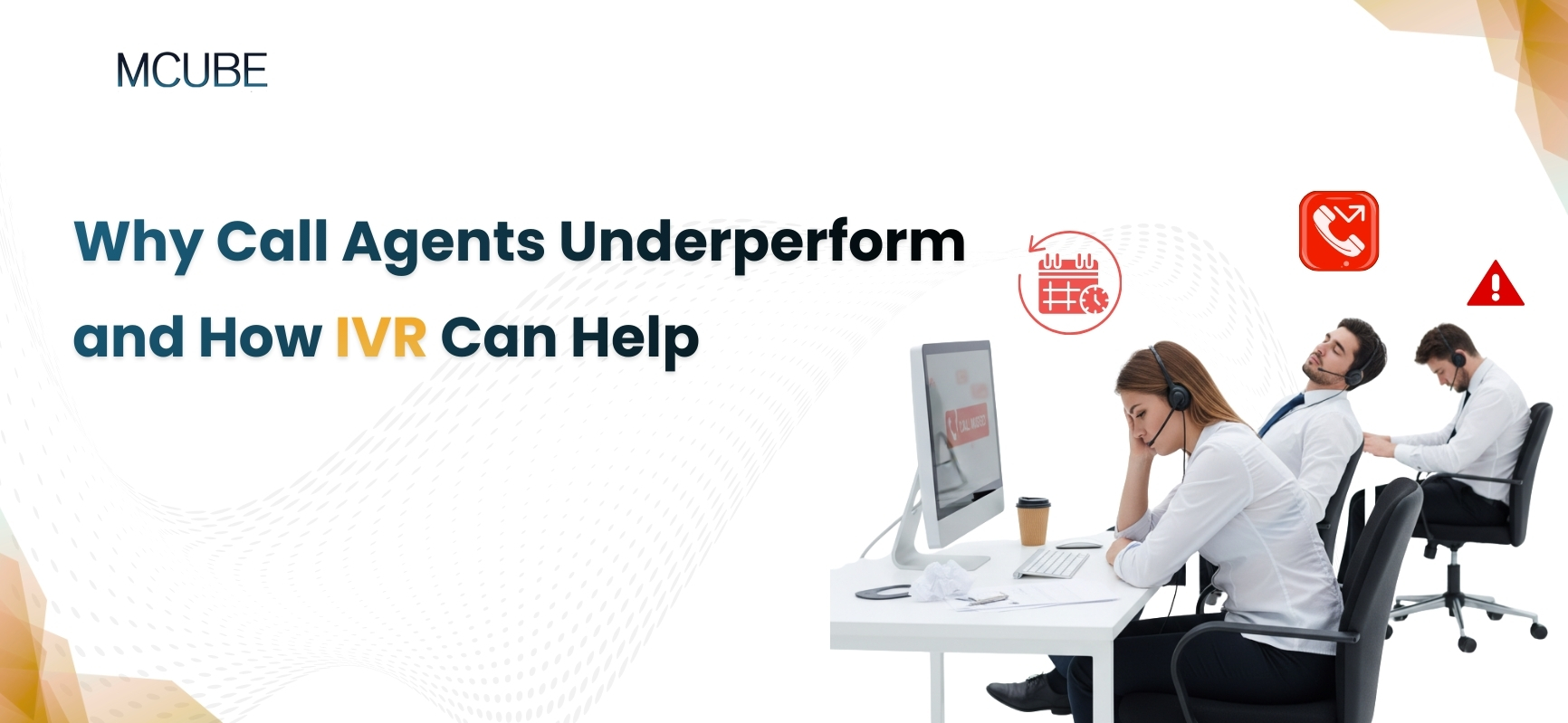
When your business call dips, the blame usually lands on the most visible in the chain: the calling agent. Even if it is low conversion rates, long call handling times, missed follow-ups, or inconsistent CX, the default response will be agent training. We are not neglecting the fact that dead air and wrong scripts do affect, but most call agents don’t underperform because they lack skill. They underperform because the system they work in is broken.
Here, an IVR platform, when designed right, can change the game. Let’s see it in detail.
The Real Reason Call Agents Underperform: Cognitive Overload
A call agent today is expected to do far more than “answer calls.”
They must:
- Identify the caller’s intent
- Switch between multiple tools and dashboards
- Remember scripts, offers, objections, and compliance rules
- Personalize conversations without real context
- Log data accurately while keeping the conversation natural
All of this occurs in real time, under pressure, and frequently in succession. This isn’t an issue with performance. The issue is one of cognitive burden. Performance inherently declines when agents are required to conduct intent detection, qualification, routing decisions, and problem-solving simultaneously. When every call begins at zero, even the most skilled agents find it difficult. Now let’s see how agent performance affects the business communication and CX.
The Hidden Causes of Call Agent Underperformance in Contact Centers
| What Businesses Notice | The Real System-Level Issue |
|---|---|
| Low conversion rates | Agents receive unqualified or incorrectly routed calls with no intent clarity |
| Long call handling times | Agents spend time discovering the problem instead of solving it |
| Inconsistent call quality | Missing context and non-standard call flows lead to uneven experiences |
| Agent burnout and attrition | Cognitive overload from juggling tools, scripts, and real-time decisions |
| Repeated training gaps | Performance depends on memory and manual effort rather than structured systems |
This is where IVR comes in, acting as the layer that fixes system flaws rather than acting as a barrier between the caller and the agent. Before a call ever reaches an agent, an Interactive Voice Response (IVR) system is used to determine the reason behind the caller’s request. It collects purpose, routes the call to the right agent, and transmits context via straightforward menu options or voice inputs. Agents get calls that have already been prepared, organized, and shaped rather than having to start every discussion from the beginning.
A well-designed IVR eliminates the need for guesswork while managing calls. It is no longer necessary for agents to spend the initial minutes determining the caller’s needs or determining whether they are even qualified to fulfill the request. Agents are able to concentrate on resolution, conversation quality, and results rather than discovery since the call is delivered with clarity.
More significantly, IVR reduces the mental stress that results in the majority of performance declines. IVR establishes a predictable call environment by filtering low-value queries, giving priority to urgent or high-intent calls, and standardizing the beginning of each contact. Because the system also focuses on helping agents’ workload and making them productive.
How IVR Helps Improve Agent Performance and CX
- Reduces the amount of time spent on call discovery by capturing caller intent up front.
- Calls are routed according to skill set, purpose, or priority rather than just availability.
- Removes needless calls by automatically responding to simple requests
- Gives agents background information before the discussion starts.
- Regardless of the level of agent experience, it generates consistent call flows.
- Helps agents remain focused and productive by lowering cognitive overload.
When agents receive the right calls, at the right time, with the right context, performance stops being a struggle. IVR does not replace human interaction. It ensures that human effort is used where it matters most.
How IVR Creates Structured Call Journeys for Better CX
The degree to which an IVR is well-designed and in line with actual call itineraries determines how effective it is. An IVR service provider can do much more than just make direct calls when it is used carefully. It ensures that every call follows a planned and purpose-driven course by shaping the entire conversation before an agent is involved. This method substitutes call handling’s randomness with control, consistency, and clarity.
IVR-based automated call routing guarantees that callers are directed to the appropriate department or agent based on purpose rather than just availability. Agents receive interactions that are appropriate for their function and area of expertise rather than dealing with low-priority or mismatched calls. This lessens frustration on both sides of the conversation and enhances first-call resolution.
Setting the tone of the client journey is a crucial function of IVR for CX. IVR produces quicker and more consistent experiences by answering common questions, gathering basic data, and providing self-service options. While agents begin interactions with the context, they need to reply successfully, and customers spend less time repeating themselves.
When companies collaborate with the appropriate IVR service provider, the distinction becomes evident. A well-designed IVR system adjusts to shifting call volumes, changing client demands, and expanding teams without impairing productivity. It absorbs complexity and maintains stable communication workflows rather than putting additional strain on agents during peak hours.
Conclusion
Underperformance by call agents is rarely an individual problem. It is nearly always caused by systems that need agents to make real-time adjustments, fragmented call paths, and lacking context. Businesses’ performance and customer experience suffer when they depend on agents to close structural gaps.
This turmoil is brought under control using IVR. It guarantees that high-intent calls are promptly routed to the appropriate agents, increasing conversions and cutting down on unnecessary work for sales teams. Appropriately channeling issues and addressing routine queries up front, it facilitates quicker resolution for support teams. By establishing expectations early and removing needless back and forth, IVR for CX provides consistency across both roles.
As a result, agents are supported rather than overworked in the call environment. Customers feel understood more quickly, conversations become more focused, and results increase without putting extra strain on teams. IVR improves support quality, boosts sales performance, and makes every customer touchpoint more seamless when it is incorporated into the communication plan.
In the end, better systems lead to better conversations. And when conversations improve, so does the business.