
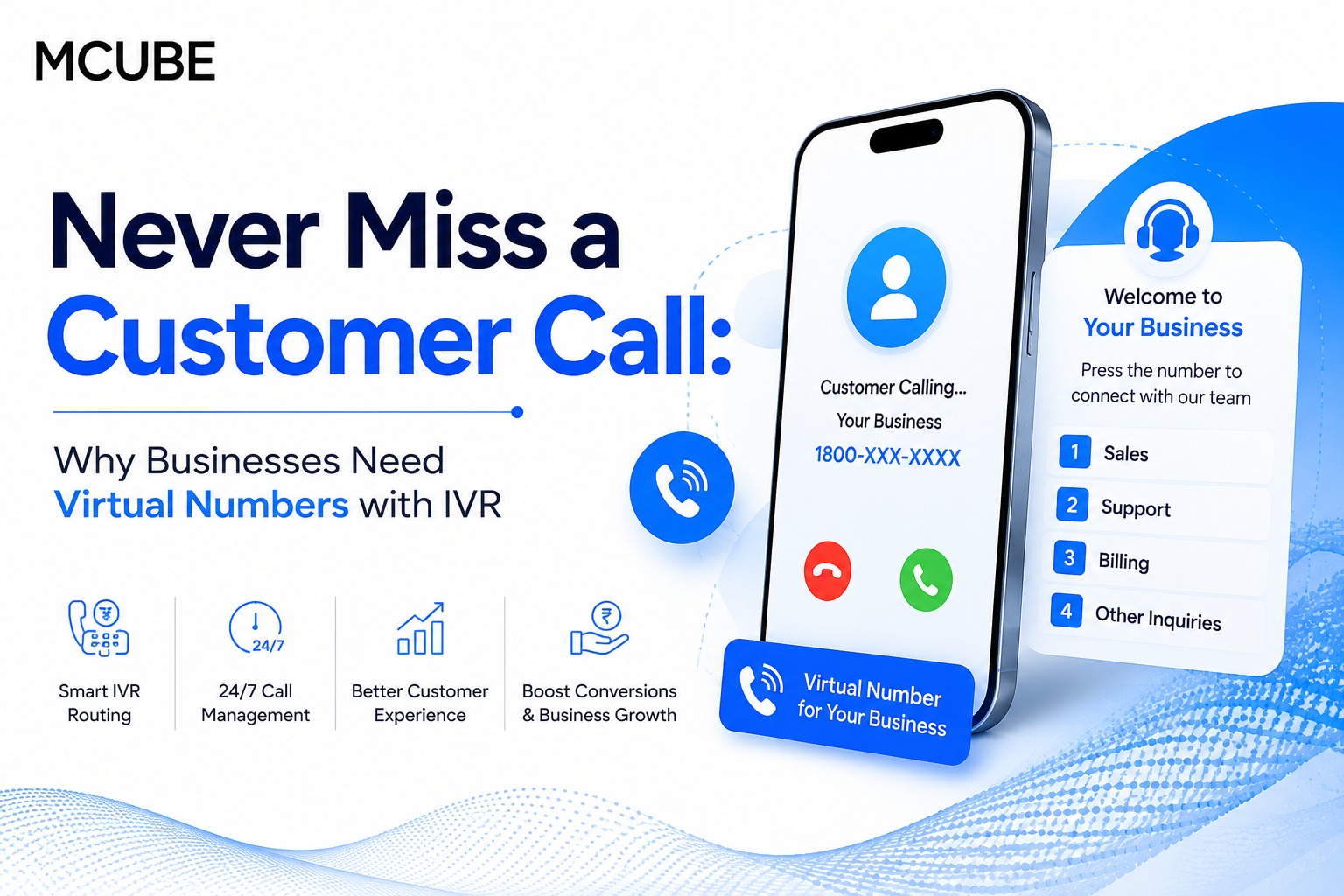
Imagine this: It’s Monday morning, and your sales team is busy with the new product launch. Just after the launch, your business phone is flooded with customer calls. There are a bulk of queries that need to be answered immediately, or you might lose a potential customer. While someone is calling to know more about your new product, another might need an update on their existing order, or someone else might be inquiring about technical support.
Now your customer support team faces challenges in handling so many customer queries at a time. Sometimes, when they focus on attending one customer query, two other customers might keep waiting in the queue, and ultimately disconnect the call. This eventually leads to the loss of potential customers and ultimately lost revenue.
It is a common scenario in real estate, banks, online help for ecommerce, and in the health care sector, every day. It’s not team management, it’s a primitive communication infrastructure that’s the common cause. Customer expectations have changed dramatically, which is why it is important to pay attention to every call. This is where Virtual Numbers with IVR come in. They form a seamless workflow that empowers businesses to handle calls efficiently, enhance customer satisfaction, and ensure that queries are directed to the right team efficiently, with no unnecessary delays.
What Are Virtual Numbers?
A virtual number is a telephonic number that is not tied to any SIM card, physical phone line, or specific device. It basically operates on a cloud-hosted infrastructure. Calls made to a virtual number can easily be routed to any device, anywhere, depending on rules the business sets up.
Most businesses utilize three common types of virtual numbers: Toll-Free Numbers for national connection without additional charges, local numbers to help establish trust in certain areas or cities, and mobile virtual numbers for keeping personal information masked in any transaction.
This is based on a flexible concept. A company can send a call from a Mumbai number, be able to track which marketing campaign that call is from, and can even block a number, and not even require any physical equipment.
What is IVR and How it Works?
IVR, or Interactive Voice Response, is an automated voice menu that greets a caller and gives them multiple options to choose from, based on their requirements, before the call reaches a human agent. It’s that smart layer of a cloud telephony system that decides whether a query actually needs human intervention or can be resolved with menu navigation.
A well-built IVR isn’t only about playing a menu. Multi-level IVR can also route a support query straight to the right product team or agent instead of a general queue. Self-service IVR can let a customer check an order status or account balance without waiting for the call to get transferred to an agent. And when human intervention is required, the system routes the call to the available agent, based on skill, language, and query type, instead of making every customer wait in a single pipeline.
Why Virtual Numbers and IVR Work Better Together?
As businesses scale, customer call volume also increases. However, these two features together solve half of the problems for handling business calls. A virtual number gives a business a professional, trackable entry point for calls; it lacks logic behind it. Every customer call still needs a human to attend the call, solve it, and direct it. On the other hand, an IVR brings the logic, but it needs a number to actually receive calls in the first place.
Combining Virtual Numbers with IVR helps solve these everyday challenges by:
- Automatically directing callers to the appropriate department
- Reducing the number of missed calls during busy hours
- Providing a single professional business number across all marketing channels
- Supporting remote and multi-location teams
- Reducing the workload on front-desk or reception staff
- Offering customers faster assistance without multiple call transfers
Instead of manual handling of every call, businesses can automate the process while maintaining a professional and responsive experience.
Key Business Benefits
Businesses that adopt a cloud-based calling system often see improvements in both customer satisfaction and operational efficiency.
- Lower Costs: Eliminates the requirement of any physical phone lines, PBX hardware, or a receptionist dedicated solely to call sorting.
- Scalability: Adding a new city, department, or campaign number takes minutes, removing the need to wait for a hardware order.
- Better Data: Every customer call is logged, recorded, and trackable back to a source, campaign, or agent.
- Stronger Brand Image: A warm greeting and organized menu feels far more professional than an unanswered call or an overwhelming response from the agent.
- Remote-friendly Operations: A cloud-based call routing facility helps agents attend customer calls from anywhere, since it doesn’t demand a physical extension.
- Higher Conversion: Faster response times and smarter routing mean there is hardly any possibility for leads to slip through the cracks.
How Does MCUBE Help Businesses Handle Calls More Efficiently?
Managing customer communication becomes a more enjoyable task when the right tools work together. MCUBE combines Virtual Numbers with a feature-rich IVR system to help businesses streamline every incoming call.
MCUBE’s single- and multi-level IVR solution comes with several features such as call routing, call recording and analytics. This means businesses don’t just use the IVR for an automated greeting; they also get a complete insight on how every call moves through their system and where issues could be resolved faster.
Combined with MCUBE’s virtual number and toll free services , businesses can manage multi-location operations, mask sensitive numbers, and monitor campaign results from a single, real-time dashboard without deploying an extra phone system. The cloud-based model expands along with the company, with no need for any hardware upgrades throughout.
Where Virtual Numbers with IVR Make the Greatest Impact
Different industries face different communication challenges, but the need for efficient call management remains the same.
| Industry | Common Call Challenges | Impact of Virtual Numbers with IVR |
|---|---|---|
| Education | High admission inquiry volumes during enrollment periods | Automatically route admission calls to counselors or relevant departments. |
| Healthcare | Managing appointments, billing, and specialist inquiries | Direct patients to the appropriate department, reducing wait times and improving service. |
| Real Estate | Multiple project inquiries and sales follow-ups | Connect buyers with the right sales representative based on project or location. |
| E-commerce | Frequent order, return, and support requests | Route customers to dedicated support teams for faster issue resolution. |
| Banking & Financial Services | Large volumes of loan, insurance, and account-related calls | Securely direct callers to the appropriate banking or financial service department. |
| Logistics | Shipment tracking and delivery-related inquiries | Route customers to shipment tracking or customer support teams for quicker assistance. |
Conclusion
When a customer call goes unattended, it’s not a big deal at that time. But multiply those over a month, over a quarter, over a year and they become lost revenue watching from the sidelines. Good communication is an essential component of every business. A missed call may cost a customer their business, and a poorly handled call may impact customer trust. Virtual Numbers with IVR are designed to complement each other and make business communication more efficient, responsive and scalable.
From scaling up for a growing startup to dealing with high call volumes at various locations, a cloud-based communication platform can make things easier. Utilizing Virtual Numbers, intelligent IVR, call routing, CRM integration, and analytics, MCUBE empowers businesses to provide quicker responses, enhance customer experience, and maintain operational efficiency.