
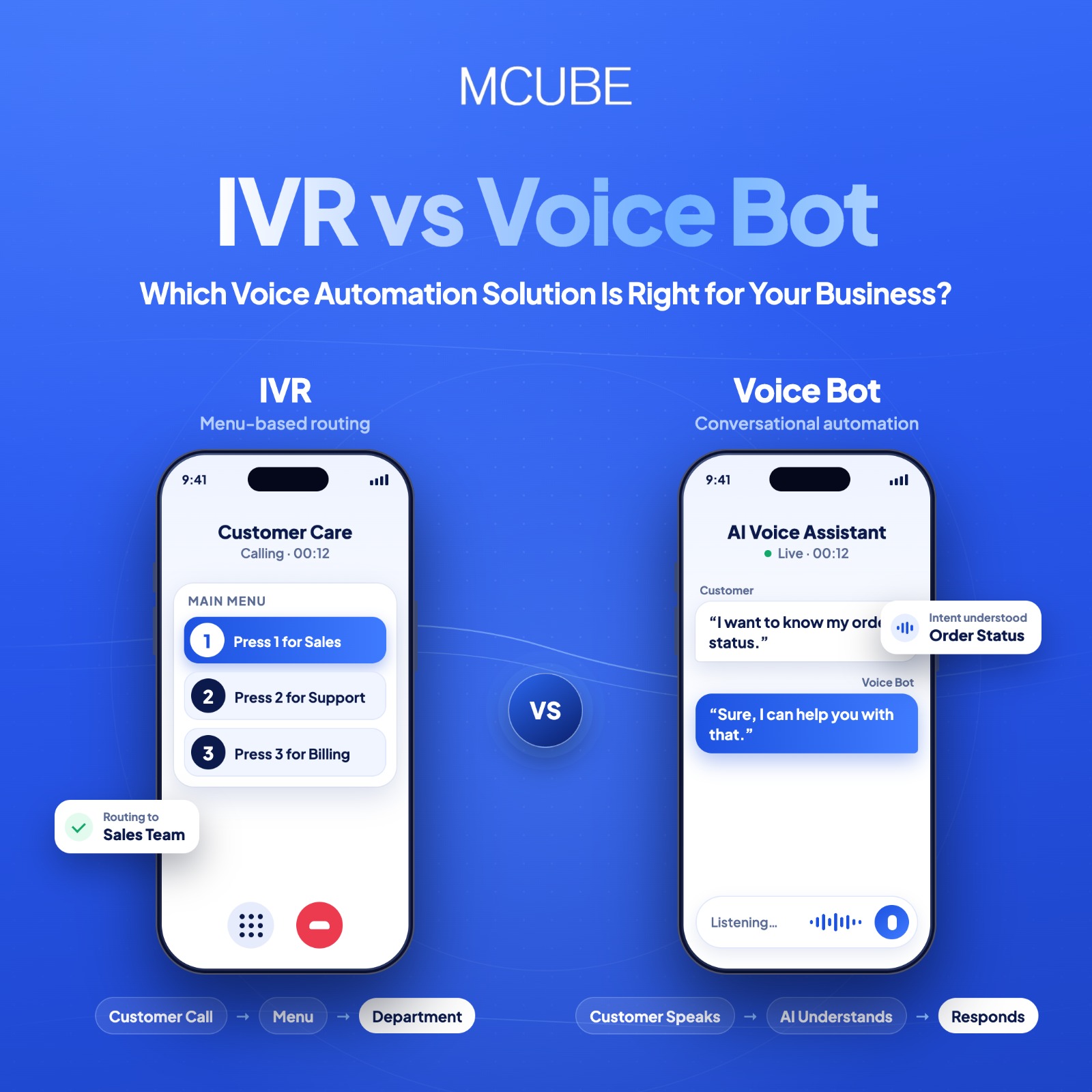
Imagine a customer calling a company with a simple question: “I want to know the status of my order.” Rather than receiving an instant response to a query, they say “Press 1 for sales, Press 2 for support, Press 3 for…” and then they have to wait for an agent!
The discussion with IVR vs. voice bot comes into play here. Both technologies enable enterprises to handle customer calls, but both deal with conversations in different ways. Structured menus and routing are the foundations of IVR, while AI voice bots can interpret verbal queries and return conversational answers.
For large enterprises handling high call volumes, choosing between the two depends on the complexity of customer interactions, automation requirements, integrations, and the experience they want to provide their customers.
What Is IVR and How Does It Work?
IVR or Interactive Voice Response, is an automated telephone system that prompts callers to follow a series of menus via keypad input or voice commands. It can direct users to the appropriate department, offer self-service, gather data and link to business systems.
An IVR vs. voice bot comparison suggests that IVR is suitable for structured and predictable queries. It’s inexpensive, easy to set up, and known to callers. IVR is typically appropriate when customers have a set sequence of steps to take, and the options for them to take are known.
For instance, a customer might choose:
- Press 1 for Sales
- Press 2 for Support
- Press 3 for Billing
- Press 4 to speak with an agent
Modern IVR systems can also handle multi-level menus, business hour routing, queues, call recording and CRM integration.
What Are AI Voice Bots?
AI voice bots hold real-time spoken conversations with callers. They work in four steps: speech recognition converts the caller’s words to text, language understanding identifies the intent, the system picks or generates a response, and text-to-speech delivers it in a natural voice.
In an IVR vs voice bot comparison, this makes AI voice bots particularly relevant for enterprises handling repetitive yet conversational interactions, such as lead qualification, appointment reminders, FAQs, customer follow-ups, and routine support.
IVR vs Voice Bot: Key Difference at a Glance
The biggest difference between IVR vs voice bot lies in how customers interact with the system and what the technology can do during a call.
| Parameter | IVR | AI Voice Bot |
|---|---|---|
| Interaction | Menu or keypad-based | Natural conversation |
| Call Flow | Predefined | Dynamic and conversational |
| Customer Input | Limited options | Open-ended speech |
| Primary Role | Call routing and self-service | Conversation and task automation |
| Personalization | Rule-based | Context and connected data |
| Best Suited For | Structured call journeys | Repetitive, conversational interactions |
A traditional IVR can efficiently direct a caller to the right team or service. An AI voice bot can go further by understanding the request and handling parts of the conversation itself.
When Should Enterprises Choose IVR?
While the customer journey might be predictable, the fundamental need is efficient call management, which fits IVR.
It may be a viable option for companies that wish to:
- Transfer callers from one department to another
- Offer language accessible menu options
- Handle high call volume inbound calls
- Develop business hour and holiday call flows
- Offer basic self-service
- Send queue priority customers to particular teams
- Use queues and routing rules to organize calls.
IVR can provide the first point of interaction for customers before they speak with an agent for a Contact Center. For inbound operations, for instance, the single- and multi-level IVR offered by MCUBE can have configured menus, routing logic, routing flows, and automated workflows.
When Should Enterprises Choose an AI Voice Bot?
An AI voice bot becomes relevant when the objective goes beyond routing calls and includes handling actual conversations.
Businesses can consider AI voice bots for:
- Follow up and qualification of leads
- Scheduling and reminder of appointments.
- Customer FAQs
- Inquiries regarding order or service.
- Payment reminders
- Customer re-engagement
- Routine support conversations
- High-volume outbound campaigns
The advantage is particularly useful when customers do not always phrase the same request in the same way. Instead of forcing them through a fixed menu, the system can interpret their spoken intent and continue the conversation.
What Should Enterprises Consider Before Buying?
The IVR vs. voice bot consideration should start with the business problem rather than the technology itself. Before choosing a platform, enterprises should evaluate:
- Call volume: Can the solution handle your expected traffic and peak periods?
- Integrations: Does it connect with your CRM, helpdesk, and business applications?
- Languages: Can it support the languages your customers actually use?
- Human handoff: Can complicated interactions move smoothly to an agent?
- Analytics: Can teams monitor calls and understand customer interactions?
- Security: Does the solution meet your data and industry requirements?
- Scalability: Can you add new workflows without rebuilding the entire system?
- Cost: Consider platform, telephony, integration, and ongoing optimization costs together.
These factors are especially important when evaluating voice automation for large enterprise operations.
How Does MCUBE Help Businesses Improve Customer Experience
MCUBE doesn’t consider voice communication as a separate offering, but rather as a component of the customer journey. Its cloud telephony solution features IVR, intelligent call routing, call monitoring, call recording, analytics and CRM integration to enable businesses to handle high call volume interactions.
Its AI Voice Bot adds conversational automation for inbound customer interactions. The system can understand intent, respond naturally, execute workflows and escalate conversations when human assistance is needed.
This combination allows businesses to use IVR for structured journeys and AI voice bots for conversational interactions, helping reduce unnecessary transfers, improve response times and keep customer conversations more consistent. MCUBE also highlights the role of cloud telephony in improving customer experience through intelligent routing and better access to customer information.
Conclusion
The IVR vs voice bot decision ultimately depends on the type of customer interaction an enterprise needs to manage.
Customers benefit from IVR when they want to browse through a simple menu of choices, dial a specific number to a department or use a simple menu to access self-service. When businesses want to allow their customers to sound natural and automate repetitive conversations, AI voice bots are the better choice.
In many businesses it’s not a matter of choosing any one. IVR and AI voice bots can complement each other: IVR can route the initial call, and the voice bot can deal with the conversational part of the call before handing it over to human agents for more complex tasks.