
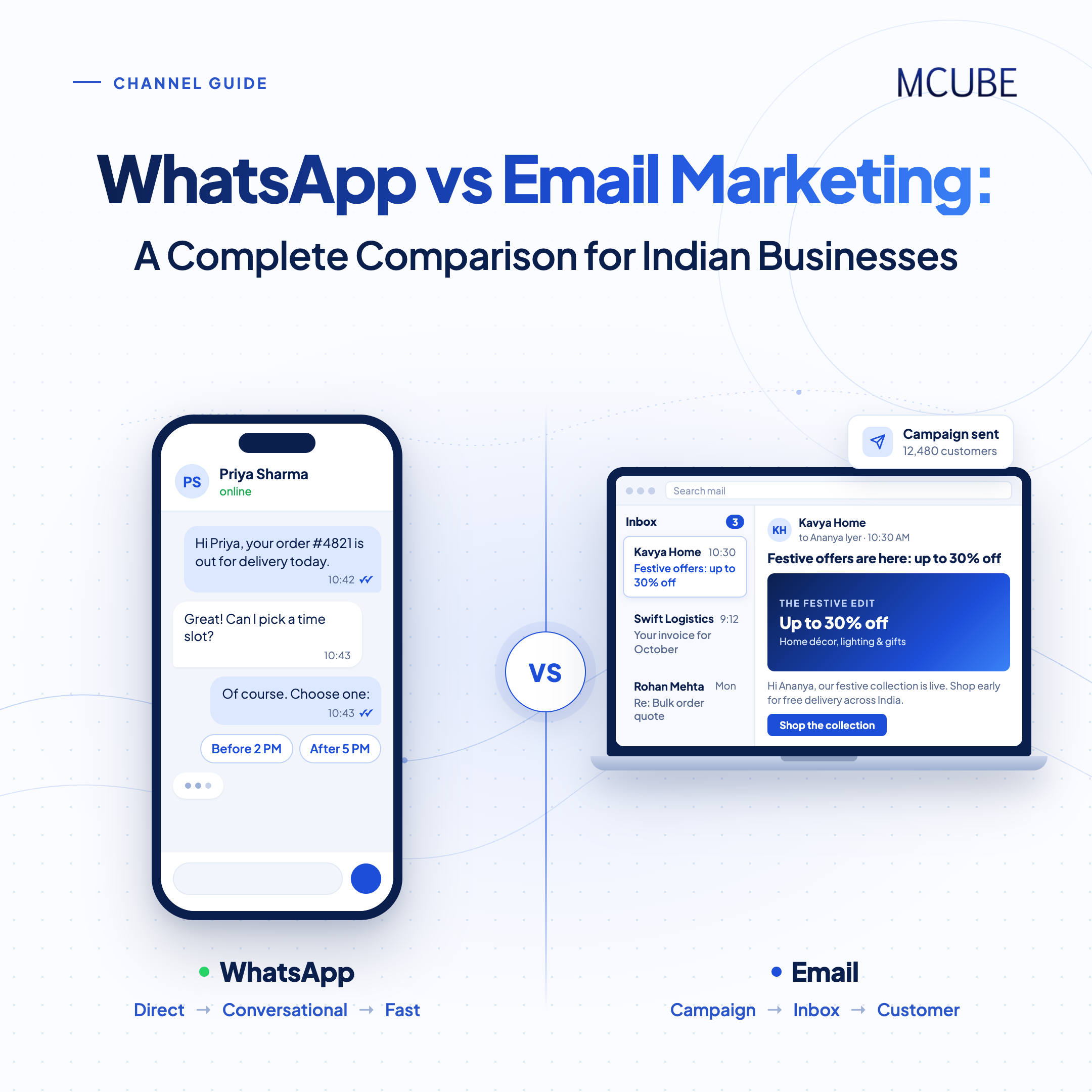
It is 10 a.m. on a Monday. A marketing team is just about to send an email marketing campaign to 20,000 customers. A subject line is written to perfection, the design is good, and the CTA directs people to the proper landing page. Now it’s up to customers to open the email and click the link.
Meanwhile, another campaign reaches customers directly on WhatsApp with a short message, a product image, and a simple reply option.
This is where the WhatsApp vs email marketing debate begins. Both channels can drive sales and engagement, but they work differently. The right choice depends on what a business wants customers to do and how quickly it wants them to respond.
Email Marketing: The Reliable Workhorse
Email continues to be the most familiar of all the channels in a marketer’s toolbox. When subscribers sign up, they receive newsletters, promotions, confirmations of their order and reminders of cart items left behind from businesses. Email marketing software should also have segmentation, automation, and comprehensive analytics to know exactly who’s opening your emails, clicking on your links, and purchasing from you.
Email has a number of great attributes, such as reach, affordable cost per send, and the ability to send long-form content. However, the weak point here is it lacks attention. Many emails end up in unopened folders and in Spam Filters. The average open rate is roughly 37% and the conversion rates are between 2% and 5%. Email is best used to send a detailed message, like a product guide, a proposal or a monthly update.
WhatsApp Marketing: The Instant Conversation
WhatsApp puts your brand inside the app customers check dozens of times a day. For simple chats and catalogs, it’s best to begin with the free WhatsApp Business App, which works well for smaller teams. When volumes increase, WhatsApp Business API steps in. It can be automated, integrated with the CRM, enabled for customer consent bulk notifications, and more.
The channel is best used for time-sensitive communications: Order updates, reminders for appointments, payment nudges, cart recovery and quick support. Messages are received instantly, including images, documents or buttons, as well as inviting a reply. That’s the two-way traffic that makes WhatsApp seem more like a conversation, than a broadcast.
WhatsApp vs Email Marketing: Which Performs Better?
There is no single answer to which channel converts better. Performance depends on the audience, campaign objective, industry, message, and stage of the buying journey.
When there is a need to initiate a conversation, or get an immediate response, WhatsApp can be beneficial. A customer can ask a question, confirm an appointment, respond to an offer, or request support, without having to leave the messaging platform.
Email, on the other hand, gives marketers more space to explain a product, share educational resources, present multiple offers, or nurture a prospect over time.
In other words, WhatsApp vs email marketing should be evaluated based on the action you want the customer to take, not just campaign metrics.
WhatsApp vs Email Marketing: Open Rates, Clicks and Conversions
| Metric | ||
|---|---|---|
| Open Rate | About 37% | Up to 98% |
| Click-Through Rate | 2–5% | 15% and above |
| Time to Read | Hours or days | Minutes |
| Conversation | Mostly one-way | Two-way |
| Engagement | Requires users to open and read | Direct and immediate |
| Best For | Newsletters, detailed content, lead nurturing | Offers, follow-ups, updates, and support |
When Should Businesses Use WhatsApp Marketing?
WhatsApp works particularly well when communication needs to be timely, personal, and easy to respond to. With the WhatsApp Business API, businesses can manage customer conversations at scale while sending personalized and automated messages.
The WhatsApp Business App can work well for smaller businesses managing conversations directly, while larger businesses may need API-based automation and integrations.
When Is Email Marketing a Better Choice?
For customers who want more information before deciding on action, email is a great channel to rely on. It provides flexibility for businesses to describe products, share resources, launch new products, and lead nurturing over a longer period of time.
Businesses can also use different email marketing platforms to segment audiences, automate campaigns, track engagement, and build structured email journeys.
For customers who are still researching a purchase, a detailed email can provide information that a short WhatsApp message may not cover.
How MCUBE Uses WhatsApp to Improve Customer Engagement
For businesses, WhatsApp can be more than another promotional channel. It can become part of the customer experience.
MCUBE’s WhatsApp Business API helps businesses automate customer interactions, send personalized messages, track message delivery and read receipts, and manage communication through a single platform. It supports use cases such as order confirmations, shipping updates, promotional offers, customer support, and two-way conversations.
It can streamline and speed up the communication process for customers. Customers are used to using the same channel to contact the business, receive updates, give feedback and receive support from the business. MCUBE also provides integration with CRM and customer service systems, which help businesses link WhatsApp conversations to their existing workflows.
WhatsApp and Email: A Better Approach Together
Customers do not follow any particular buying journey. They may discover a product through email, search for it on the website, inquire on WhatsApp, and later return to email before making a decision.
That is why omnichannel marketing is better than communicating via just one channel. Email is great for customers seeking information, and WhatsApp for rapid customer interaction.
For instance, a new product can be introduced in an email and provide information regarding it. A WhatsApp message can then follow up on the offer, address any questions, or offer a direct path to purchase for an interested customer.
Together, both channels can engage in different parts of the customer journey.
Conclusion
There is no one-size-fits-all winner when it comes to WhatsApp vs email marketing. Quick conversations, time-sensitive communication, personalized follow-up and customer support, these are all areas where WhatsApp is perfect. While email is not the primary channel for sales, it still has value for in-depth content, newsletters, education and nurturing.
The savvy approach is to know what customers are looking for at every step of the journey and select the channel that best fits the need. Mixing them up may yield seamless customer experiences, better engagement and easier interactions for customers for many businesses.