
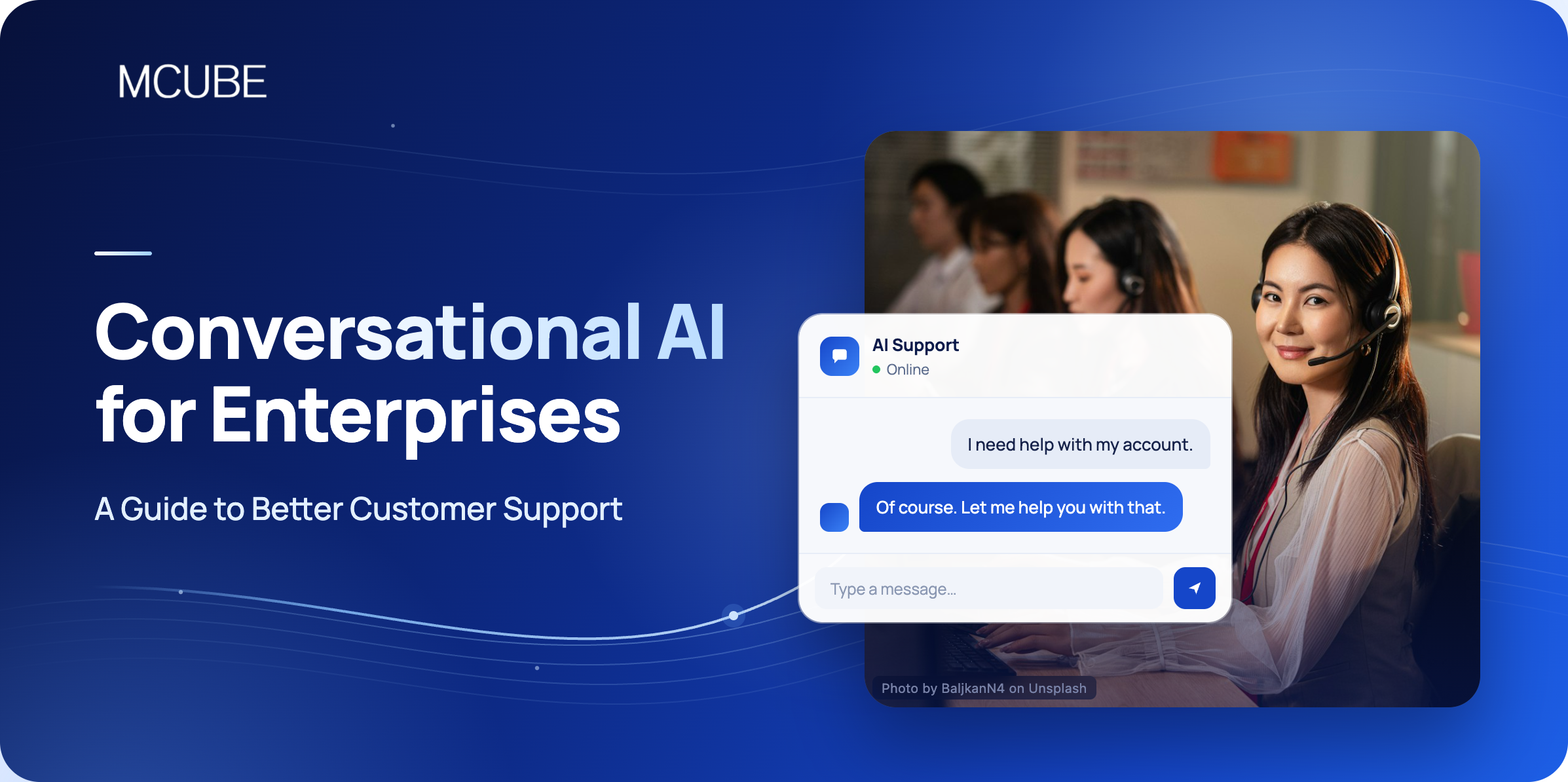
Imagine a customer service representative in a medium-sized store on a Monday morning. At 9:30, 400 customers are on hold and most of them are interested in where their orders are. The agents are constantly asked this question and a customer who has a true billing dispute has to wait half an hour for someone to answer. She’s not looking to hire more people! She has to get the routine calls out of her way so that her people can see to the tough calls.
In another scenario, a customer contacts a bank to see what the status of an application for a loan is. They dial several IVR menus, and end up in a queue and never get a response. Now take the same customer and show them how they receive instant response, information and are redirected to an agent, if required.
Conversational AI for enterprises can make a difference in these scenarios. With customer expectations constantly increasing, businesses must have quicker and more convenient response systems to their enquiries. Conversational AI can cut down on repetitive interactions, improve response times, and make sure customers have a consistent experience, freeing up more time for support agents to deal with complex issues.
What Is Conversational AI for Enterprises?
Conversational AI for enterprises refers to technology that enables businesses to communicate with customers through natural, interactive conversations. It uses technologies such as natural language processing, speech recognition, and generative AI to understand customer requests and provide relevant responses.
Unlike the traditional IVR systems with pre-recorded menus, conversational AI can direct your customer’s intent and act accordingly with the context of the conversation. It can also pull information, update records, book appointments, and start certain workflows, depending upon the system and integrations.
These capabilities make conversational AI useful across customer service, sales, banking, healthcare, education, and other industries where timely communication matters.
How Conversational AI for Enterprises Improves Customer Support
Businesses manage many thousands of interactions with customers over various channels. Manual handling of each request can lead to delays, backlogs and impact on service quality. Conversational AI for enterprises can help overcome these challenges in various ways.
- 24/7 customer assistance: Respond to common queries even outside regular business hours.
- Faster query resolution: Provide immediate answers to supported requests, eliminating the needs for customers to wait for an agent to become available.
- Personalized interactions: Use available customer information and the history of conversations to provide more relevant responses.
- Reduced agent workload: Automate repetitive tasks so support teams can focus on complex tasks.
- Consistent communication: Maintain accuracy and consistency in communication with customers through defined workflow.
- Seamless escalation: Transfer conversations to human agents when a request needs more expertise or more personal attention.
Together, these capabilities help businesses improve service accessibility while making better use of their support resources.
Personalized Conversations Across Every Channel
Customers rarely stick to one channel. They might start on web chat, follow up on WhatsApp, and finish on a call. This is where conversational AI for enterprises goes beyond a basic chatbot. It integrates with your CRM, and can use purchase history, previous tickets, and stated preferences to respond appropriately, rather than just with the first name. Multilingual support is equally important and in India customers want to be supported in Hindi, Kannada, Tamil and other languages. Regional languages and dialects are not a problem for good conversational AI platforms, and require no dedicated team for each.
How Conversational AI for Enterprises Turns Every Call Into Insight
Most contact centers review only a small sample of calls, and by the time findings reach operations, they’re out of date. AI can transcribe and analyze every conversation. It captures sentiment, repeated complaints, churn drivers and early indications of churn. Those patterns can indicate to you where there are scripts that need some improvements to it, there are agents that need some coaching and there are product issues that are keeping the calls coming back in. Rather than trying to theorize about what customers are unhappy about, teams can actually view this in the data.
Traditional Customer Support vs. Conversational AI Platforms
The traditional approach is based on agents and IVR menus which are in place. Conversational AI platforms take it a step further by handling eligible interactions and assisting agents in handling more complex requests.
| Area | Traditional Support | Conversational AI |
|---|---|---|
| Availability | Often depends on staffing hours | Can provide support beyond business hours |
| Query Handling | Primarily manual | Automates supported routine requests |
| Response Time | May involve queues | Can provide immediate responses |
| Scalability | May require additional staffing | Can handle multiple interactions simultaneously |
| Human Involvement | Agents manage most requests | Agents focus on issues requiring human judgment |
How MCUBE AI Voice Bots Improve Customer Experience and Engagement
For enterprises that rely heavily on phone communication, AI voice agents offer a practical way to manage customer calls without making every interaction dependent on an available representative.
MCUBE’s AI Voice Bot enables businesses to handle inbound customer interactions through natural conversations. It can understand customer intent, respond in real time, and execute configured tasks through workflow automation. Businesses can also configure call flows, voice personas, and escalation rules to suit their support requirements.
Here is how MCUBE AI Voice Bots can support customer experience and engagement:
- Handle routine calls: Reply to standard inquiries and minimize manual activity.
- Manage high call volumes: Support businesses during peak hours to provide customer service.
- Support timely follow-ups: Automate configured communication workflows to keep customers informed.
- Connect with business systems: Integrate with supported telephony and CRM systems to log interactions and trigger actions.
- Enable human assistance: Route conversations to a human agent when a request falls outside the bot’s configured capabilities.
By making support more accessible and reducing unnecessary delays, MCUBE AI Voice Bots can help enterprises build more responsive customer communication processes.
What Should Enterprises Consider Before Adopting Conversational AI?
Successful implementation involves more than selecting a technology platform. Businesses should consider the following:
- Identify the right use cases: Start with frequent, repetitive queries that are suitable for automation.
- Integrate existing systems: Integrate with supported CRM, telephony, and customer service systems.
- Protect customer data: Set up the proper security measures and access limits.
- Measure performance: Response times, resolution rates, customer satisfaction and escalation rates.
- Plan for human support: Ensure customers can reach an agent when the AI cannot resolve their request.
A phased rollout is beneficial for enterprises to detect gaps, assess outcomes and optimize workflows before going all in.
Conclusion
Customer support is no longer about answering questions anymore. It now involves providing timely, relevant, and convenient support. Businesses can use conversational AI to automate regular queries, improve accessibility, and focus their resources and time on more intricate issues.
With the help of AI-powered tools such as MCUBE AI Voice Bots, businesses can automate voice interactions, streamline processes, and improve customer engagement. When integrated with the right use cases and escalation paths and implemented correctly, an enterprise can help provide customers and employees with a better customer support experience.