
A few years ago, a small furniture business owner in Pune noticed something was wrong in her process. She wasn’t losing sales due to lack of interest in her products, just that her business was failing to attend to customers on time. Orders were received via Instagram DMs, missed calls, and some emails that went unread for 3 days. By the time she had time to reply to any customer, they had already moved elsewhere.
Now imagine a customer inquiring about your product at 8:30 PM. Your sales team has already logged off, but the customer still expects an answer. The next morning, they may have moved on to another business that responded faster. You didn’t lose the customer because of unavailability; you lost them due to an incorrect process.
That’s the exact gap WhatsApp Business API was built to close. It now serves as the backbone of the communications between businesses and their customers, as well as being used to confirm orders, remind customers, and stay connected with them without having your business inundated with a production line of support staff.
The Benefits of WhatsApp Business API extends beyond just messaging. It can be utilized for automating interaction, associating customer conversations with CRM systems, handling multiple representatives, and making more convenient customer encounters.
What Is WhatsApp Business API?
The WhatsApp Business API is designed for businesses that need to manage customer conversations at a larger scale. Unlike the WhatsApp Business App, which is primarily suited to smaller teams and direct one-to-one communication, the API can connect WhatsApp to business tools, automation workflows, CRM systems, and multi-agent setups.
The benefits of WhatsApp Business API include customer support, sales follow-ups, notifications, marketing communications, appointment reminders, and other customer-facing interactions. The right platform can also help teams organize conversations and connect them with existing workflows. MCUBE, for example, offers WhatsApp Business API capabilities, automation, and CRM integration for business communication.
10 Benefits of WhatsApp Business API for Businesses
Wider Customer Reach
Customers have already been using WhatsApp to communicate with one another on a daily basis and are very familiar with the platform, so they are more likely to use it for business communications. It can be employed to respond to queries, share product information, send updates and provide support without a need for customers to learn a new platform.
This familiarity can make it easier for customers to initiate and maintain business interactions. You’re not asking people to download yet another app or to watch a channel they don’t use much; you’re reaching them where they are.
Faster Response to Customer Queries
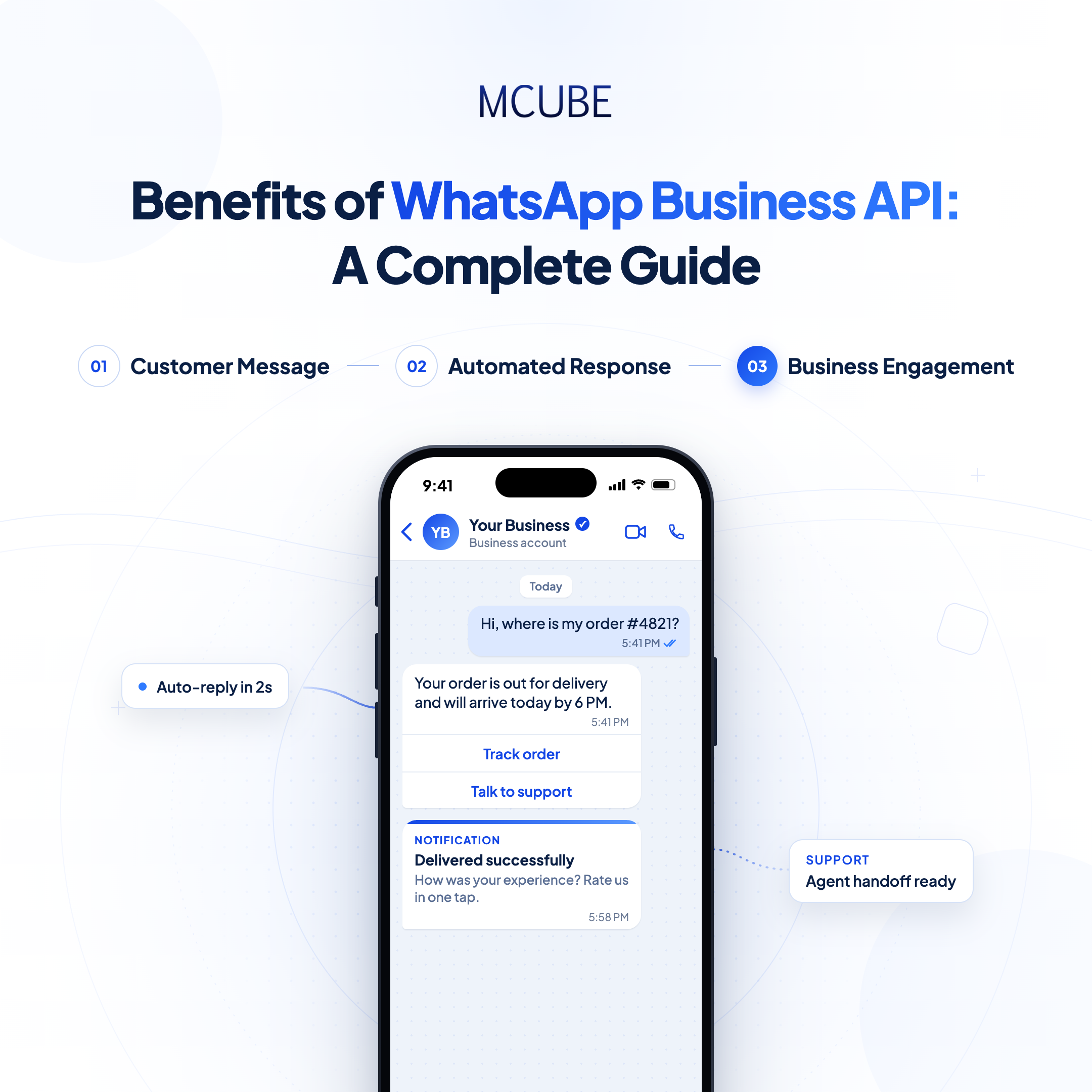
A delayed response can mean a missed opportunity, particularly when the customer is exploring several business options. Businesses can achieve quick responses to repetitive queries by using automated replies, templates, and streamlined agent workflows.
Here are some ways that businesses can leverage WhatsApp:
Businesses can use WhatsApp for:
- Frequently asked questions
- Appointment confirmations
- Order and delivery updates
- Lead enquiries
- Payment reminders
- Support requests
The quicker they can communicate, the easier it will be to handle the customer and the less stressful it will be for customer support and sales representatives.
Automated Repetitive Conversations
Think of a customer conversation that doesn’t involve an employee throughout the entire process. You can schedule repetitive activities like FAQs, notifications, reminders, qualification of leads, and simplest support requests.
For more complex queries, automated conversations can be handed over to a live agent. MCUBE also highlights chatbot-to-agent workflows and automated customer support as part of its WhatsApp Business capabilities.
This is one of the practical benefits of WhatsApp Business API for teams handling a large number of similar inquiries every day.
Rich Multimedia Messaging
Text alone may not always be enough to explain a product, service, or process. WhatsApp allows businesses to communicate using different content formats, including images, videos, documents, links, and interactive elements.
A retailer can share product information, an education company can send course details, and a service business can share documents or instructions.
These richer conversations can make it easier for customers to understand information and take the next step without moving to another channel.
Improved Lead Engagement & Follow-ups
A lead may show interest today but requires multiple interactions before a decision is made. There is a solution: WhatsApp can help businesses connect all along the way.
Responses can be automated, relevant content can be shared, reminders can be sent about pending actions, and qualified leads can be transferred to the sales representatives.
Personalized Custom Communication
Customers are more likely to engage when a message is relevant to their situation. Customer data and communications history can be leveraged to tailor interactions and create more personalized experiences for customers.
For example, a company can send:
- A personalized appointment reminder
- A follow-up based on a previous inquiry
- An order-related update
- Product information based on customer interest
- A targeted promotional message
This helps businesses move from generic broadcasts to more relevant customer conversations.
Scalable Customer Engagement
As a business grows, its customer communication needs grow with it. More customers mean more inquiries, notifications, follow-ups, and support requests.
A structured WhatsApp API setup allows businesses to combine automation, multiple agents, CRM integration, and predefined workflows rather than relying entirely on manual communication.
This is one of the most significant benefits of WhatsApp Business API for companies that need to handle growing communication volumes without turning every interaction into a manual task.
Integration with CRM Tools
Customer conversations become more useful when they are connected with the information businesses already have.
WhatsApp API can integrate with CRM and other business systems, helping teams connect conversations with customer records, leads, follow-ups, and sales activity. This reduces the need to switch between multiple platforms or manually copy information.
MCUBE supports CRM integration as part of its WhatsApp Business API offering, helping businesses bring messaging into their broader customer communication workflow.
WhatsApp Business API Use Cases Across Industries
| Industry | WhatsApp Use Case | Business Benefit |
|---|---|---|
| E-commerce | Order updates, delivery notifications, product queries | Keeps customers informed and engaged |
| Education | Admission inquiries, counselling, reminders | Improves lead follow-ups and student communication |
| Healthcare | Appointment reminders, patient communication | Reduces missed appointments and improves convenience |
| Real Estate | Lead follow-ups, property details, site visits | Helps sales teams engage and nurture leads |
| Banking & Finance | Alerts, service updates, customer support | Enables faster and convenient customer service |
| Travel & Hospitality | Booking updates, confirmations, customer support | Keeps travellers updated throughout their journey |
How Does MCUBE Help Businesses Improve WhatsApp Communication
MCUBE’s WhatsApp Business API solution helps businesses bring WhatsApp communication into their existing customer engagement processes. Businesses can use automation, templates, CRM integration, and two-way conversations to manage customer interactions more systematically.
This can help sales teams follow up on leads, customer support teams respond quicker, and the operations team get timely notifications. Integrating WhatsApp with other communication channels and business tools can help businesses keep track of the context of customer interactions. The integration of WhatsApp with other communication channels and business tools allows businesses to keep a better track of the context of the interactions with their customers.
Conclusion
The benefits of WhatsApp Business API is not theoretical; they are evident in reduced customer dropouts, quicker responses and meaningful conversations that lead to conversions. From small businesses looking to prevent losing sales to poor response times to companies with thousands of conversations every day, the advantages of a WhatsApp API for business continue to grow. If you are thinking about the option for yourself as a business, you should look at how solutions such as MCUBE’s WhatsApp Business API can be incorporated into the workflow you already have in place.