
Imagine a sales agent starting the day with a list of 200 customer numbers. They dial the first number, wait for the call to connect, note the outcome, and then move to the next. By the end of the day, a significant part of their time may have gone into dialing, waiting, and handling unanswered calls rather than solving real customer issues.
This is where the auto dialer feature can make a difference. But not every outbound campaign needs the same kind of solution. The choice between a predictive dialer vs. progressive dialer depends on call volume, agent availability, campaign goals, and the kind of customer conversations involved.
Both are used for outbound calling automation, but have different ways of calling the number. Being aware of the difference can aid businesses with determining the setup they need to support their agent productivity and customers.
What Is a Predictive Dialer?
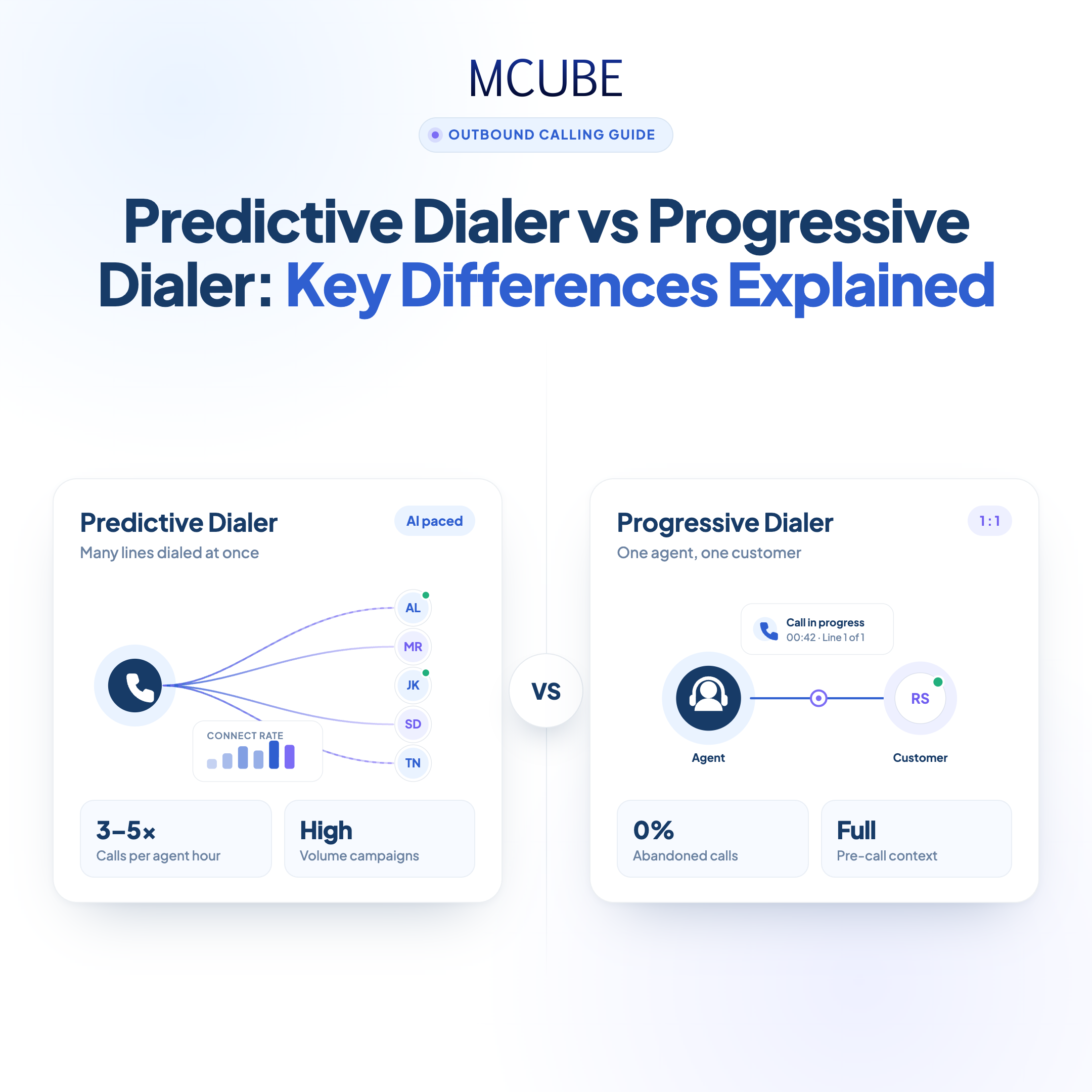
A predictive dialer takes a more aggressive approach to outbound calling. It uses calling patterns and agent availability to determine when and how many numbers to dial.
The system can place multiple calls while agents are still engaged in existing conversations. When a customer answers, the connected call can be routed to an available agent. Unanswered, busy, or unsuccessful attempts can be handled automatically, allowing agents to spend less time waiting between conversations.
This makes a predictive dialer particularly useful for large contact lists and high-volume campaigns where maintaining a steady flow of customer conversations is important.
In simple terms, progressive dialing waits for an agent to become available before placing the next call, while predictive dialing attempts to anticipate when agents will become available.
What Is a Progressive Dialer?
A progressive dialer automatically places the next call when an agent becomes available. Instead of dialing several numbers at once, it maintains a more controlled calling pace, generally keeping an available agent matched with the next outbound call. This way, agents also have a few seconds to review the contact record before speaking.
This approach gives agents a smoother transition from one conversation to another and reduces the likelihood that a customer will answer when no agent is ready. It can be useful for follow-ups, reminders, customer service callbacks, and sales conversations where agents need to pay attention to the individual customer.
In a predictive dialer vs progressive dialer comparison, progressive dialing places greater emphasis on controlled calling and agent readiness rather than maximum calling speed.
Predictive Dialer vs. Progressive Dialer: Key Differences
| Factor | Progressive Dialer | Predictive Dialer |
|---|---|---|
| Calling Method | Calls when an agent becomes available | Places multiple calls based on predicted agent availability |
| Calling Pace | Controlled and steady | Faster and higher-volume |
| Agent Idle Time | Low | Designed to minimize idle time |
| Customer Interaction | More controlled and personalized | Focuses on maintaining a high call volume |
| Best Suited For | Follow-ups, support and personalized outreach | Large-scale sales and outbound campaigns |
| Operational Priority | Agent readiness and controlled calling | Agent utilization and higher call throughput |
Predictive Dialer vs. Progressive Dialer: Which One Fits Your Business?
A business should consider its campaign requirements before selecting a dialing mode.
A progressive dialer may be suitable when:
- Agents conduct individual customer communications.
- Calls are related to follow-up, reminders, or relationship management.
- The team prefers a slow calling speed.
- Customer interaction is more important than reaching the maximum number of contacts.
- The campaign has moderate call volumes.
A predictive dialer may be suitable when:
- Agents handle large volumes of outbound calls.
- The contact list is extensive.
- Reducing agent idle time is a priority.
- Campaigns involve sales, lead qualification, or collections.
- The business needs a faster calling cycle.
The right choice also depends on team size, average call duration, and the quality of the contact database.
How Does MCUBE’s Auto Dialer Support Customer Engagement?
For businesses managing large outbound campaigns, an auto call dialer can take much of the manual work out of calling. MCUBE’s auto dialer offers predictive, progressive, and preview dialing modes, allowing teams to select a method based on their campaign requirements.
Its predictive mode helps ensure that the agents are connected to live calls, while the progressive mode is more structured in its calling process. The platform also offers campaign management and integrations to enable businesses to organize outbound communication.
As a cloud telephony company, MCUBE positions its auto dialer around improving outbound productivity while helping businesses manage customer interactions more systematically. When agents spend less time manually dialing and more time speaking with customers, businesses can maintain more consistent follow-ups and smoother customer engagement.
What to Consider Before Choosing a Dialer?
Before deciding between a predictive dialer vs progressive dialer, businesses should look beyond the number of calls a system can place.
Consider:
- Call volume: How many outbound calls does the team handle each day?
- Team size: How many agents are available at the same time?
- Campaign goal: What are you trying to accomplish in the campaign?
- Complexity of conversation: Is it necessary for agents to have customer history for each conversation?
- Customer experience: How important is a controlled and personalized interaction?
- CRM integration: Does the dialer need to work with existing customer records?
- Reporting: What campaign and agent performance data does the team need?
A dialer should fit the way the team works rather than forcing the team to change its entire calling process.
Conclusion
The predictive dialer vs progressive dialer decision ultimately comes down to the balance a business wants between calling speed and control. A progressive dialer works well when agents need a steady flow of calls and more control over each interaction. A predictive dialer is more suited to high-volume campaigns where keeping agents occupied and increasing outbound throughput are key priorities.
Businesses must take into account the number of calls to make, their team size, campaign objectives and the level of interaction required from their customers when choosing. An auto call dialer can help agents spend more time on meaningful conversations with more customers, while minimizing manual effort, depending on the user’s dialing mode.