
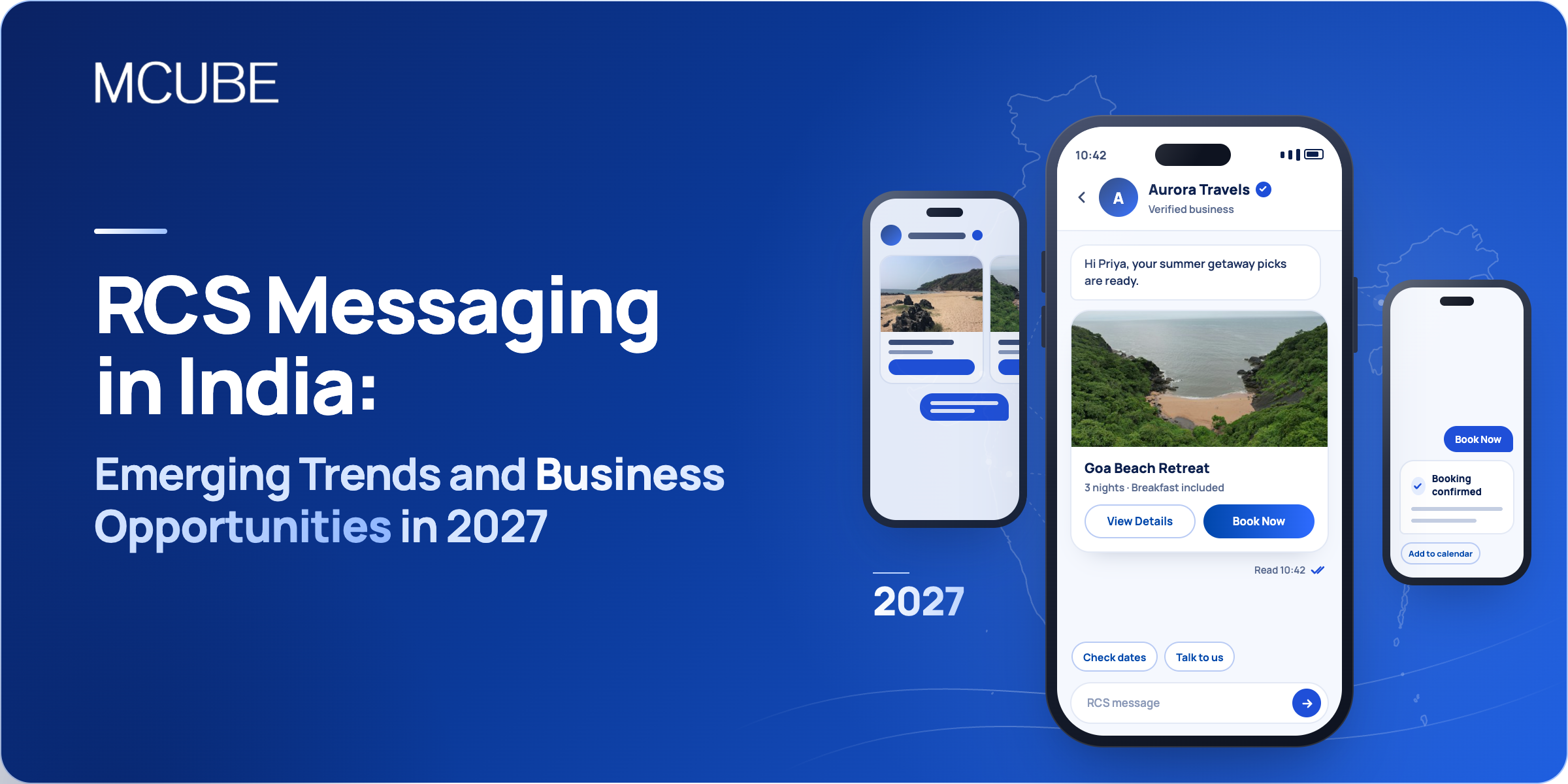
Imagine a customer receiving a promotional SMS from a retail brand. It contains a short message and a link to the website. Now, imagine receiving the same offer with product images, a discount banner, a carousel of recommendations, and a button to shop directly. Which message is more likely to catch your attention?
RCS (Rich Communication Services) makes a significant difference for business communication. With brands trying to reach their customers more effectively, RCS messaging in India is quickly becoming a focus. RCS provides interactive features, multimedia, and personalized messaging, which revolutionizes the way businesses communicate with their customers. Its continued use in 2027 could open up novel business avenues in all sectors.
Understanding the Growth of RCS Messaging in India
As smartphones become more prevalent and the internet is becoming more accessible in India, and people are more inclined towards digital communications, richer messaging experiences are becoming important. Additionally, businesses are exploring SMS beyond the traditional messaging and seeking to make it more engaging and actionable.
With RCS messaging, brands can send messages with images, videos, carousels, suggested replies, and clickable buttons via compatible messaging apps. It allows for a more interactive experience in the messaging interface, as compared to SMS.
As businesses are navigating the ever-evolving communication scenario, the need to improve customer engagement methods is a critical need that makes RCS messaging in India a vital tool for them. Compatibility with devices, network infrastructure, and customer readiness will be factors used to determine whether or not the technology is adopted.
Emerging RCS Messaging Trends to Watch in 2027
The approach businesses take to communicate with customers is expected to be more interactive and personalized. Here are the developments that need to be monitored:
Trend 1: Conversations Replace Broadcasts
One-way alerts are giving way to two-way chats. A customer can schedule a service appointment, check on a loan balance, or choose a product without leaving the thread. First line queries are answered by chatbots and if the query becomes complex, the human agent comes into the picture. Payment links and automatic follow-ups make the journey from interest to purchase seamless. RCS campaigns are no longer broadcasts, but rather conversations that recall the last thing the customer did.
Trend 2: Trust Becomes the Differentiator
Customers have learned to not pay attention to unknown senders; fraud has made them even more cautious. The first question that a user will ask for a received RCS message is: Who is this from? Here in India, a brand verified by the brand name, logo, and check mark, answers that question for them. This is particularly important for banks and fintech, where spoofing can be a possibility at any time. There is equal value placed on consent records and in terms of compliance with regulations. There’s a difference between businesses that make trust a product and a legal footnote in the manual, and those that don’t. There is a difference between companies that make trust a product as opposed to a footnote in the manual.
Trend 3: RCS Works Best Alongside Other Channels
RCS rarely works alone. A common pattern is to send on RCS first, fall back to SMS, then follow up by voice or WhatsApp. An IVR line can be used by customers that prefer to speak. The objective is to have one customer journey through the channels, with getting the entire insight of the data into one view. Teams that are able to tie these channels together understand which messaging works where, and don’t waste money sending the same message three times.
Business Opportunities Created by RCS Messaging in India
The possibilities for businesses to communicate with their customers through RCS extend beyond just sending out promotional text messages. Its interactive capabilities can support various touchpoints in the customer journey, from discovery to post-purchase communication.
There are some significant business opportunities:
- Interactive Marketing Campaigns: Use images, videos, and carousels to highlight products, discounts and seasonal offers.
- Lead Generation: Add inquiry, registration, and booking buttons to help the customers to take action.
- Transactional Updates: Order confirmations, delivery notifications, payment reminders, or appointment notifications are sent in the form of transactional updates.
- Customer Support: Respond promptly to regular customer questions with automated replies.
- Personalized Communication: Share relevant offers and updates based on customer preferences and interactions.
For businesses exploring RCS messaging in India, these features can help drive a more convenient customer experience, but also provide the ability to measure communication efforts.
Where RCS Messaging in India Works Best
Some sectors are already witnessing positive returns:
- BFSI and fintech: Offers related to cards, reminders about EMI, and onboarding steps.
- Retail and e-commerce: Cart recovery, tracking details of order, and product carousels.
- Real estate: Site-visit bookings with project images and location pins.
- Travel: Itineraries, boarding updates, and faster rebooking.
- Healthcare: Appointment reminders and report alerts.
A real estate company, for example, may add a button to its web page for a potential purchaser to reserve a visit to its premises and add property images to the web page. Likewise, a retailer can feature new products on the product carousels. Businesses that depend on consistent communication with their customers find that RCS messaging in India is relevant for such applications.
RCS Messaging vs Traditional SMS: What Makes It Different?
Traditional SMS has been an effective form of communication for years. But as a text-only format, the amount of information that businesses can send in one message is capped. RCS comes with multimedia content, branded sender profiles and interactive features, offering a more sophisticated option.
| Comparison Factor | Traditional SMS | RCS Messaging |
|---|---|---|
| Message Format | Plain text | Rich multimedia |
| Branding | Sender identification is restricted | Branded business profile visibility |
| Media Support | Text and links | Images, videos, and carousels |
| Interactivity | No interactive buttons are added | Fast replies and CTA buttons |
| Read Receipts | Usually not available | Provided |
| Customer Engagement | Primarily one-way | Supports interactive conversations |
Business Opportunities in 2027
The first noticeable benefit is engagement. Messages that appear and behave like an app receive greater taps than text messages. The second is clarity; reads, clicks, replies, all show which RCS campaigns work and which don’t. Routine questions are also answered by the support teams with ease just by using buttons. Combine RCS messaging with your existing CRM information and offers can be tailored by purchase history or city. Brands who are newly launching in the market also increase recognition before everyone else.
How MCUBE Helps Businesses Adopt RCS
When moving towards richer customer interactions, it’s crucial to select the right communication platform. Through its Rich Communication Services solution, MCUBE provides businesses with RCS messaging in India to build personalized, interactive and branded messaging experiences.
It has an RCS solution with the following helpful features:
- Interactive Messaging: Send messages with quick reply buttons, carousels, and rich media.
- Multimedia Support: Send images, videos, audio and documents to deliver information more effectively.
- Brand Customization: Ensure consistency of brand by using branded headers, logos, and color themes.
- Delivery and Read Notifications: Understand when and if the message was delivered to and read by the customer.
- Customizable Templates: Develop message templates that can be customized for promotional messages, updates, and customer communications.
- CRM and ERP Integration: Integrate messaging workflows into business systems.
These features enable businesses to manage RCS campaigns, enhance their customer interactions and have better insight into the performance of their messaging. Its RCS support also offers an avenue for businesses to scale the branded communication across customer touchpoints.
Conclusion
RCS is revolutionizing mobile communication for businesses. It can help you integrate rich media, branding, and interactivity, which opens new doors for customers. The adoption of richer communication experiences by businesses and customers will be key to the success of RCS messaging in India. RCS could be more beneficial throughout marketing, sales, and customer service with AI-powered personalization, conversational messaging, and improved network connectivity.
As the RCS ecosystem expands, companies that begin to consider relevant use cases early, will be better equipped to capitalize on these communication channels. It is important to get useful messages out to customers and encourage them to engage in useful conversations, not just more messages.