
A customer dials your business number with a simple query. One of your agents answers, provides the required information, and disconnects the call. On the surface, it looks like a successful interaction.
But what if the customer sounded frustrated halfway through the call? What if the agent took a long pause before answering? What if there was an uncomfortable silence before the response? Or what if the customer mentioned a recurring problem that could affect hundreds of other customers?
There is no such way to understand all these parameters because once the calls get disconnected, these details can easily be lost in the recording. For businesses handling hundreds or thousands of calls every day, listening to every conversation manually is simply next to impossible.
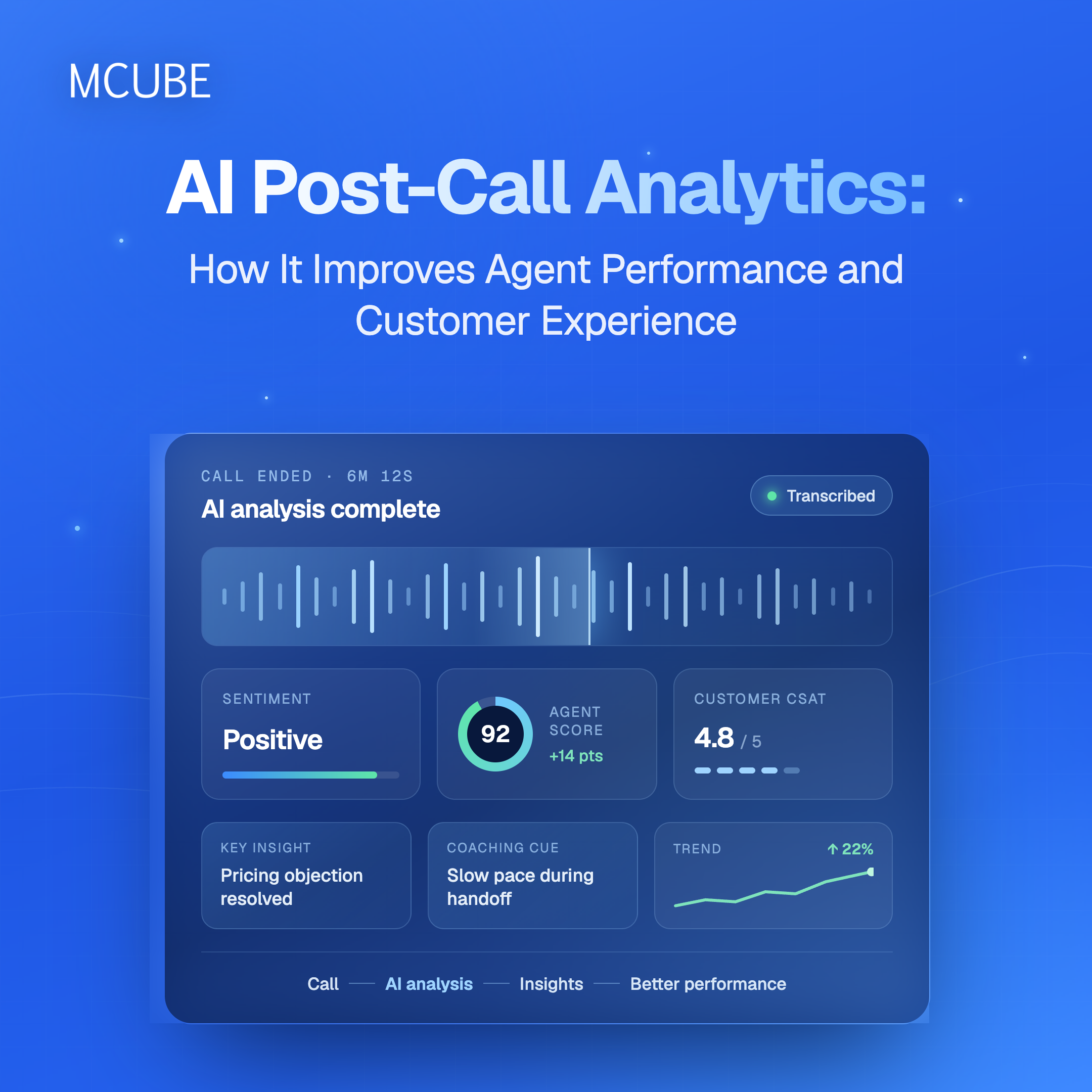
This is where AI post-call analytics comes into the scenario. Rather than reviewing a few conversations, AI evaluates each customer call, transcribing the conversation, compiling sentiment and performance metrics, and providing you with thorough reports. To wrap up: It saves completed conversations as useful information that can enhance the quality of service for businesses, provide better insights into customers, and optimize agent performance.
What is AI Post-Call Analytics?
AI post-call analytics is the process of evaluating customer conversations to identify useful patterns, performance gaps, and customer insights once a call has ended. It basically uses AI and Natural Language Processing to evaluate every customer conversation after the calls are disconnected. Speech recognition converts the call into text, language models understand tone and intent, and dashboards surface patterns across agents, teams, and time periods.
Instead of relying entirely on supervisors to listen to every random call recording, AI can examine conversations at scale and identify important details such as:
- What was the customer query regarding
- How was the conversation flow
- Customer sentiment and emotion
- Whether the agent followed the required script
- Where the conversation had dead air moments
- What the agent handled well
- Where additional training may be required
Without requiring a QA lead to guess which five calls “probably” reflect the floor’s health, the system reviews all of them consistently, without fatigue, or bias toward whichever call happened to be memorable.
Why Traditional Call Monitoring Has Its Limits
Call recordings have always been useful for quality assurance. The problem lies in manually evaluating every call to understand agent performance.
A supervisor may select a few calls, listen to them, score the agent, and provide feedback. But when a contact center handles thousands of conversations, a small sample cannot always reveal recurring problems across the entire team.
This is where AI-powered post-call analytics makes a remarkable difference.
| Aspect | Traditional Call Monitoring | AI Post-Call Analytics |
|---|---|---|
| Call Review | Reviews selected calls | Analyses conversations at scale |
| Analysis | Requires manual listening | Automates conversation analysis |
| Feedback | Feedback can take time | Insights are generated quickly |
| Coverage | Depends heavily on sampling | Provides broader visibility |
| Issue Detection | Identifies individual issues | Identifies recurring patterns |
| Coaching | May be subjective | Supported by conversation data |
How Does Post-call Analytics Improve Agent Performance?
Agent performance is not just about determining the number of calls an employee handles. It also depends on how effectively they communicate, understand customer concerns, and resolve issues.
This is where post-call analysis can provide useful context.
For example, if an agent consistently takes long pauses while searching for information, the issue may not be the agent’s communication skills. It could point to a knowledge gap, a complicated process, or difficulty accessing customer information.
Likewise, if the agent is constantly going off-script, managers may wish to explore how much more training is needed, or whether there is a better workflow.
AI post-call analytics can aid enterprises in the following ways:
- Identify training opportunities: Managers can target training on particular miscommunications or handling issues, rather than broad feedback.
- Monitor script adherence: Companies can ensure that agents are following the script and communication guidelines.
- Detecting dead air: If there’s a long silence, it can be marked for review and used to indicate when conversations stall.
- Recognize strong performance: Analytics can also identify agents who consistently handle particular types of conversations well.
- Support training consistency: Recurring patterns can reveal areas where teams need additional product, process, or communication training.
How Does Post-call Analytics Improve Customer Experience?
Better agent performance eventually shows up in the customer experience.
Think about a customer who is already frustrated by explaining their issue. If the next agent understands the previous conversation and gets the issue right, the customer is less likely to repeat the same information.
Similarly, knowing customer sentiment can assist organizations determine if the interaction was a good one or if there was a lack of resolution of frustration.
Sentiment analysis proves to be useful in this instance. Through the analysis of positive, neutral and negative emotion in conversations, businesses can start to find patterns that can’t be detected by simple call metrics.
Post-call analytics can therefore help businesses:
- Identify recurring customer complaints.
- Understand changes in customer sentiment.
- Improve follow-up processes.
- Identify gaps in issue resolution.
- Maintain more consistent service quality.
- Find opportunities to improve customer interactions.
How Does MCUBE AI Post-call Analytics Help Maintain Business Productivity?
MCUBE’s AI post-call analytics feature is a practical example of how such an intelligent feature can make a significant difference in customer call handling and agent performance. Rather than reviewing a few calls, it processes every conversation and surfaces four things a QA or support team actually needs: a post-call summary for a quick read on what happened, script adherence tracking to confirm agents stayed within brand and compliance guidelines, dead-air detection to catch moments where a customer may have felt ignored, and sentiment analysis to gauge whether a caller left the conversation satisfied or frustrated.
Combined, these capabilities provide supervisors a quicker path to pinpointing coaching moments, assist groups avert dissatisfaction escalating to churn, and provide leadership the type of performance-based information they need, past the weekly spot-check. That change alone can make the difference between responding to problems and a business catching them early if they are taking many calls per day.
Conclusion
A call recording provides you with the content of a call. Post-call analytics provides you with insight into the meaning for your business. That distinction is important when a contact center is engaged in a significant number of customer interactions.
The process becomes a continuous loop that starts from evaluation of every customer conversation and performance insights, and leads to agent coaching for better interactions. This ultimately results in improved customer experience.
Over time, these insights can help businesses move beyond simply checking whether an agent followed a process. They can start understanding which behaviours lead to better conversations, where customers experience friction and what their teams need to improve.
That is the real value of AI post-call analytics. Every customer conversation becomes another source of information that can help the next conversation go better.