
Thousands of calls for appointments were received daily in a regional hospital network. A phone system was only able to handle menu selections, while patients wanted to book, reschedule or inquire about a doctor’s availability. A patient saying “I need to move my checkup to next week” often ended up on hold for a human agent. Staff spent their valuable times on routine rescheduling rather than on urgent cases.
As a business expands, so do the number of customer calls it receives. A few calls a day can quickly escalate to hundreds of calls related to your order, payment, appointments, and support requests. Without automation, it can be hard to deal with all the interactions that happen, yet simple automated replies might not help.
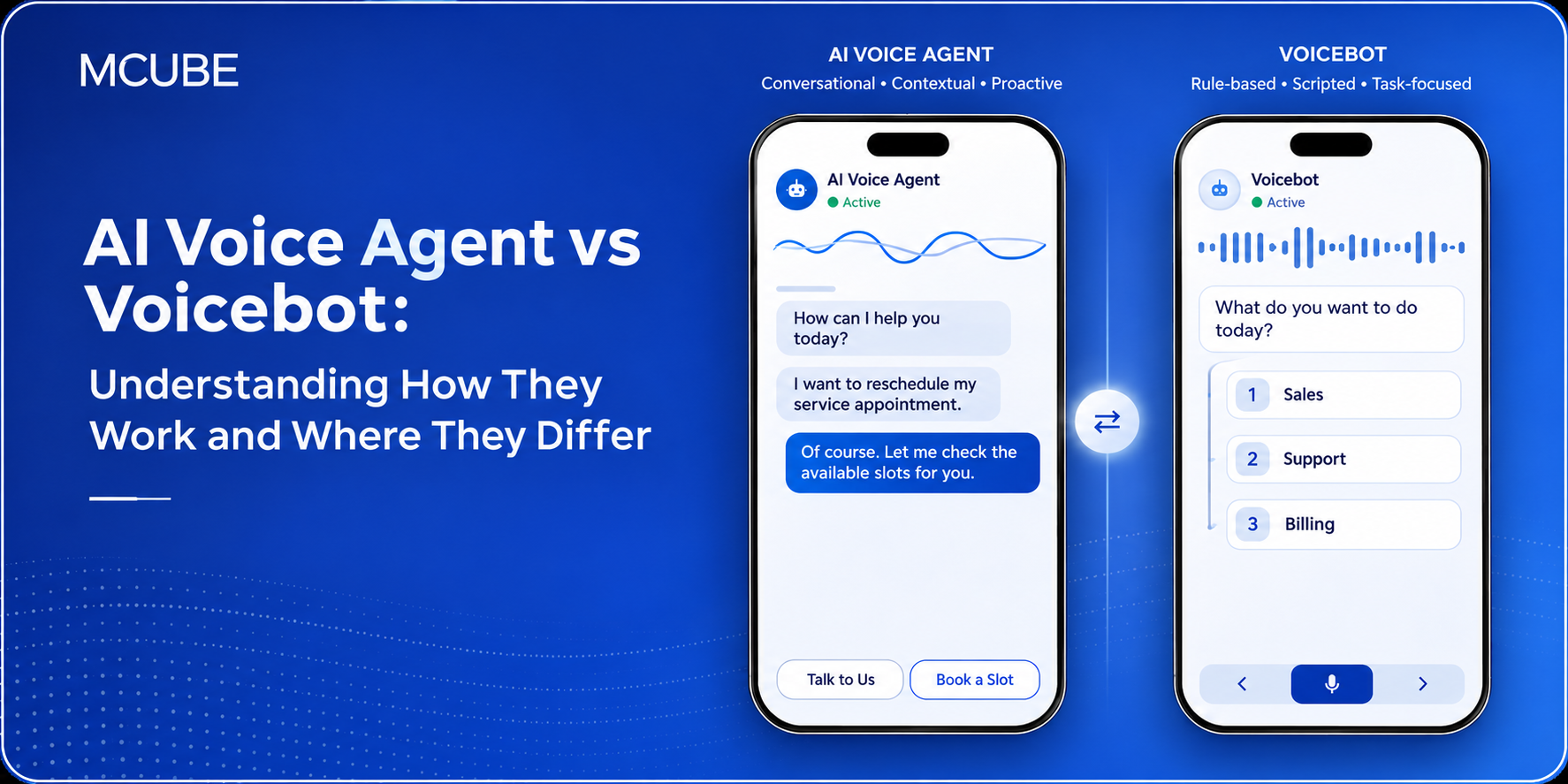
This is where the AI voice agent vs voicebot comparison comes into play. While both solutions support automation of calls, they have distinct differences in how they comprehend customer needs, answer queries, and handle conversations.
What is a Voicebot?
Voicebot is an automated system that interacts with callers using pre-recorded scripts, prompts and workflows. It uses speech recognition to understand customer inputs and provides responses based on programmed commands.
Voicebots are typically employed by businesses for:
- Responding to questions that are commonly asked.
- Providing information on orders and appointments.
- Directing callers to the right department.
- Responding to customer service queries.
Traditional Voicebots work well when conversations follow predictable paths. However, they may struggle when customers ask unexpected questions or move away from the predefined conversation flow.
What Is an AI Voice Agent?
An AI Voice Agent is a conversational system that understands natural language, interprets customer intent, and responds based on the context of a conversation.
It uses technologies such as Automatic Speech Recognition (ASR), Natural Language Processing (NLP), and Large Language Models (LLMs) to manage dynamic conversations.
Unlike traditional bots, an AI Voice Agent can follow-up with other questions, fetch data from interwoven systems and initiate actions via APIs. It can auto-enrich a sales lead, verify appointment availability, or update customer records while on the call for instance.
This makes it useful for businesses looking to automate more than basic customer interactions.
AI Voice Agent vs Voicebot: 7 Key Differences Businesses Should Know
Although both solutions automate voice interactions, their capabilities differ in several ways. Here are seven important features of AI voice agent vs voicebot that businesses should consider.
| Comparison Factor | Traditional Voicebot | AI Voice Agent |
|---|---|---|
| Conversation Style | Carries out established procedures and cueing. | Enables natural, dynamic discussions. |
| Understanding Intent | Identifies certain keywords or programmed inputs. | Recognizes purpose, situation and variation of speech. |
| Complex Queries | Handles straightforward, predictable tasks. | Handles complex queries and follow-ups. |
| Personalization | Provides standard responses. | Adapts responses using customer data and conversation context. |
| Workflow Execution | Handles simple answers and call routing. | Fetches data, updates CRM records, and triggers workflows. |
| Human Handoff | Transfers calls to an agent based on a set of conditions. | Escalates conversations with relevant context for human agents. |
| Improvement | Requires manual script and workflow updates. | Can be refined using conversation data and performance insights. |
The key difference in the AI voice agent vs voicebot comparison is the ability to understand changing conversations and take action beyond predefined responses.
Benefits of Using Voicebots for Businesses
Voicebots help businesses to handle a routine customer interaction without having to involve a human agent in every call. They are ideal for repetitive queries, simple information retrieval, and call routing. This automates these jobs, allowing businesses to maintain communication flow during peak times with reduced agent burden.
There are several advantages to consider such as:
- 24/7 Availability: Answer frequently asked customer questions after business hours.
- Reduced Operational Costs: Automate repetitive calls and save manual effort.
- Faster Call Handling: Ensure that callers are routed to the appropriate department without being bounced around unnecessarily.
- Consistent Responses: Provide consistent information using predefined responses.
- Better Call Management: Handle multiple routine interactions at a time.
Voicebots are a viable option for companies with well-defined and repetitive customer interactions.
Benefits of Using AI Voice Agents for Businesses
AI Voice Agents can support businesses with more flexible and context-aware customer interactions. They can process natural language instead of strict scripts, follow-up questions, and execute tasks by connected systems, rather than relying solely on pre-stored scripts. Because of this, they are beneficial in many different areas of the business, including sales and customer support.
Some key benefits include:
- Natural Conversations: Understand customer intent and respond based on the context.
- Improved Customer Experience: No need to ask customers for information multiple times to answer follow-up questions.
- Automated Task Execution: Schedule appointments, qualify leads, and get customer information.
- CRM Integration: Connect and synchronize customers information with integrated systems.
- Scalable Support: Manage high call volumes while decreasing routine work for human agents.
AI Voice Agents are ideal for businesses seeking to replace simple call automation and handle more complex customer interactions.
When Should Businesses Choose a Voicebot or an AI Voice Agent?
The right choice will vary according to your business needs, volume of calls and the nature of the calls.
Choose a traditional Voicebot when:
- You receive repetitive and predictable queries for your business.
- Basic call routing and menu-based navigation is required.
- Your customers are responded to according to a predetermined procedure.
- You would like to automate basic support tasks.
Choose an AI Voice Agent when:
- Customers frequently ask complicated or unusual questions.
- You need to have multilingual and context-aware conversations. .
- You need automated lead qualification and appointment booking for your business.
- You want to connect voice interactions with CRM systems and backend workflows.
Businesses can also combine IVR and AI-powered voice automation to manage different stages of the customer journey.
How MCUBE Helps Businesses with AI-Powered Voice Automation
AI Voice Agents by MCUBE can support businesses with more flexible and context-aware customer interactions. They can process natural language, follow-up questions, and execute tasks by connected systems, rather than relying solely on predefined scripts. Because of this, they are beneficial in many different areas of the business, including sales and customer support.
Some of its key capabilities include:
- Multilingual conversations: Understand customer intent and respond to the context.
- Customizable agent personas: Set up voice, tone, vocabulary, and conversation style to reflect your brand.
- Context retention: Keep up conversation flow between a series of questions and responses.
- CRM and API integrations: Retrieve customer information, update records, and trigger backend actions.
- Automated workflows: Support sales, customer service, and operational processes.
- Human escalation: Set rules to route conversations that require personal assistance.
These features allow companies to streamline their customer service, cut down on repetitive tasks, and keep a close eye on customer interactions.
Conclusion
The AI voice agent vs voicebot comparison hinges on the complexity of the conversations you’re handling for your business. While traditional Voicebots work best for repetitive and predictable interactions, AI Voice Agents are more flexible with contextual understanding, and can execute workflows. Businesses need to review their underlying business needs and objectives before deciding on a solution. They can leverage conversational automation with MCUBE’s AI Voice Bot in their everyday business communication.