
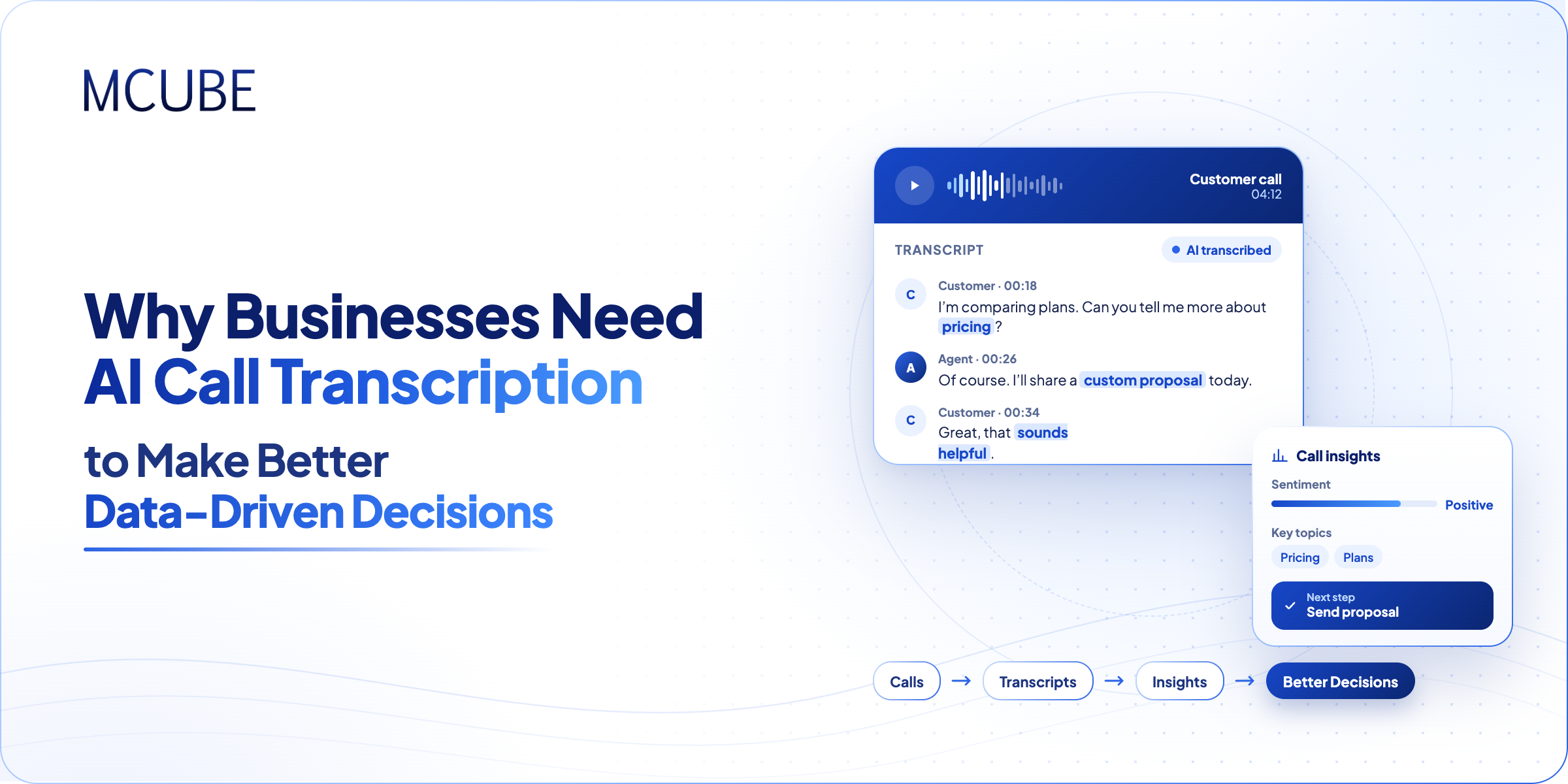
A sales manager reviews the monthly report. Lead numbers are good, but there’s a decline in conversions. The support team has been getting more complaints, but the “why” is still not clear. Meanwhile, hundreds of customer calls are taken daily and valuable information is lost amidst conversations that no one has time to review.
It is a frequent issue faced by businesses. Customer calls include customer feedback, buying signals, objections, and service related concerns. AI call transcription enables businesses to transform these interactions into text that is easily searchable, providing them with a clearer understanding of their customers, repeated patterns, and the ability to make decisions based on genuine calls and interactions, not assumptions.
What Is AI Call Transcription and How Does It Work?
AI Call Transcription involves the use of speech recognition software to transcribe audio calls into text. Teams can read through the transcriptions of calls, search them for particular details, and grasp the content of a call without having to listen to recordings.
Usually, it’s a recording of the phone call, speech recognition, and then text transcription.Typically, the process will include capturing audio recordings, processing the speech, and then transcribing the text. It can also recognise topics of conversation, words spoken and speakers, depending on the technology.
With call analytics, transcription becomes more valuable. Sentiment analysis can be used to analyze customer sentiment, uncover common discussion points, monitor sales objections, & gauge agent performance. It provides managers with a more accurate view of the situation over all customer interactions.
Why Businesses Need AI Call Transcription for Data-Driven Decisions
Customer conversations often reveal problems that traditional reports cannot explain. Sales data may show a decline in conversations, but customer calls may show that the prospects are worried about pricing, features or follow up being delayed.
AI call transcription makes it easier for businesses to review and analyze these details. Teams can track recurring questions, know the customer’s expectations and see patterns in hundreds of interactions.
This helps businesses:
- Understand customer preferences and their challenges.
- List out common sales objections.
- Identify lacks in services and unresolved complaints.
- Assess how well agents are communicating and performing.
- Induce knowledge-informed decisions on marketing, selling, training, and customer experience.
Rather than just having snippets of feedback, managers can view conversation data to see how customers are talking consistently.
Key Business Insights You Can Extract from Call Transcripts
Call transcripts enable businesses to gain insights into customer behavior and determine where the attention is needed. These learnings can help inform decisions made in various departments.
- Recurring Customer Complaints: Find the most common complaints and enhance products, services and customer support operations.
- Sales Objections: Identify customer objections and improve sales and pricing messages.
- Customer Sentiment: Measure customer satisfaction and make efforts towards enhancing customer experience and loyalty.
- Frequently Asked Questions: Look for common questions and update FAQs and customer support replies.
- Agent Performance Gaps: Identify gaps in agent performance and schedule coaching and training that address these needs.
- Buying Signals: Identify customer interest and prioritize leads and follow-ups.
For instance, when the same product functionality is requested by customers over and over, the product team can use this feedback to prioritise the product improvements. Likewise, consistent pricing issues can influence sales teams to adapt to their strategies.
How AI Call Transcription Improves Decision-Making Across Teams
Call insights can help various departments in making day-to-day decisions and long-term planning.
- Sales: Identify customer objections, buyer intent and conversion inhibitors to enhance follow-ups.
- Customer Support: Find common problems, resolution gaps, and customer complaints.
- Marketing: Understand customer language, preferences, and pain points to make more relevant marketing campaigns.
- Operations: Look for inefficiencies, communication gaps, and training needs.
- Management: Evaluate team performance and customer experience using conversation insights.
With access to actual customer conversations, teams can make decisions based on what customers need rather than what they assume customers want.
AI Call Transcription vs. Manual Call Review: How They Differ
Manual call reviews are good for quality assurance, but dealing with a lot of recordings is time consuming. AI call transcription simplifies conversations to make them easier to process, search and evaluate.
| Factor | Manual Call Review | AI Call Transcription |
|---|---|---|
| Review process | Listening to recordings | Going through searchable transcripts |
| Time required | Time-consuming | The ability to access information more rapidly. |
| Coverage | Often restricted to particular calls | Supports larger call volume analysis |
| Searchability | Hard to identify particular details | Search keywords and conversation topics |
| Insights | Depends on reviewer observations | Can be combined with AI-powered analytics |
| Decision-making | Often based on sample reviews | Uses broader conversation data |
AI transcription is not meant to replace human judgement. It saves teams from wasting time reviewing recordings and allows them more time to act on what they learn.
How MCUBE Helps Businesses Turn Calls Into Actionable Insights
The AI-powered Post-Call Analysis solution offered by MCUBE does more than just listen to a call; it empowers businesses to derive insights from customer conversations. This AI call transcription solution transcribes audio and offers insights to assist managers with analyzing customer interactions.
Key capabilities include:
- Call Transcription: Transcribe calls into text for convenient reviewing.
- Post-Call Summaries: Comprehend the main ideas from the recording without having to listen to it all.
- Sentiment Analysis: Determine whether the customer’s sentiments are positive, neutral, or negative.
- Script Adherence: Assess compliance of agents to a set of rules in place for communication.
- Dead-Air Detection: Recognize dead-air moments and communication issues.
The capabilities help managers to identify coaching opportunities, understand the common complaints of customers, and improve the quality of services offered. The insights gained from these can be used by businesses to make informed decisions about training agents, customer experience, and processes.
Best Practices for Using Call Transcription Data Effectively
Nothing is more useful than transcripts when businesses have an established system for how to utilize the information contained. To unlock the potential of AI call transcription in real-world decision-making:
- Define what you want to learn from customer conversations.
- Monitor recurring complaints, keywords and sales objections.
- Combine call insights with CRM and sales data.
- Don’t get caught up in individual calls, but focus on trends regularly.
- Apply findings to redesign scripts, workflows and employee training.
- Handle customer information with care and ensure proper access to the information.
The goal is not simply to collect transcripts. It’s about acting on the feedback from your customers and making improvements in the way that you do.
Conclusion
Every customer conversation offers an opportunity to understand what is working and what needs improvement. AI Call Transcription enables businesses to focus on these insights, uncover patterns, and make decisions in sales, support, marketing, and operations.
Businesses can leverage MCUBE‘s AI-driven Post-Call Analysis to learn more than just the content of the calls, they can gain insights into customer sentiment, agent performance, and call outcomes. Improved insights can result in improved processes, improved customer relationships, and informed business decision making.